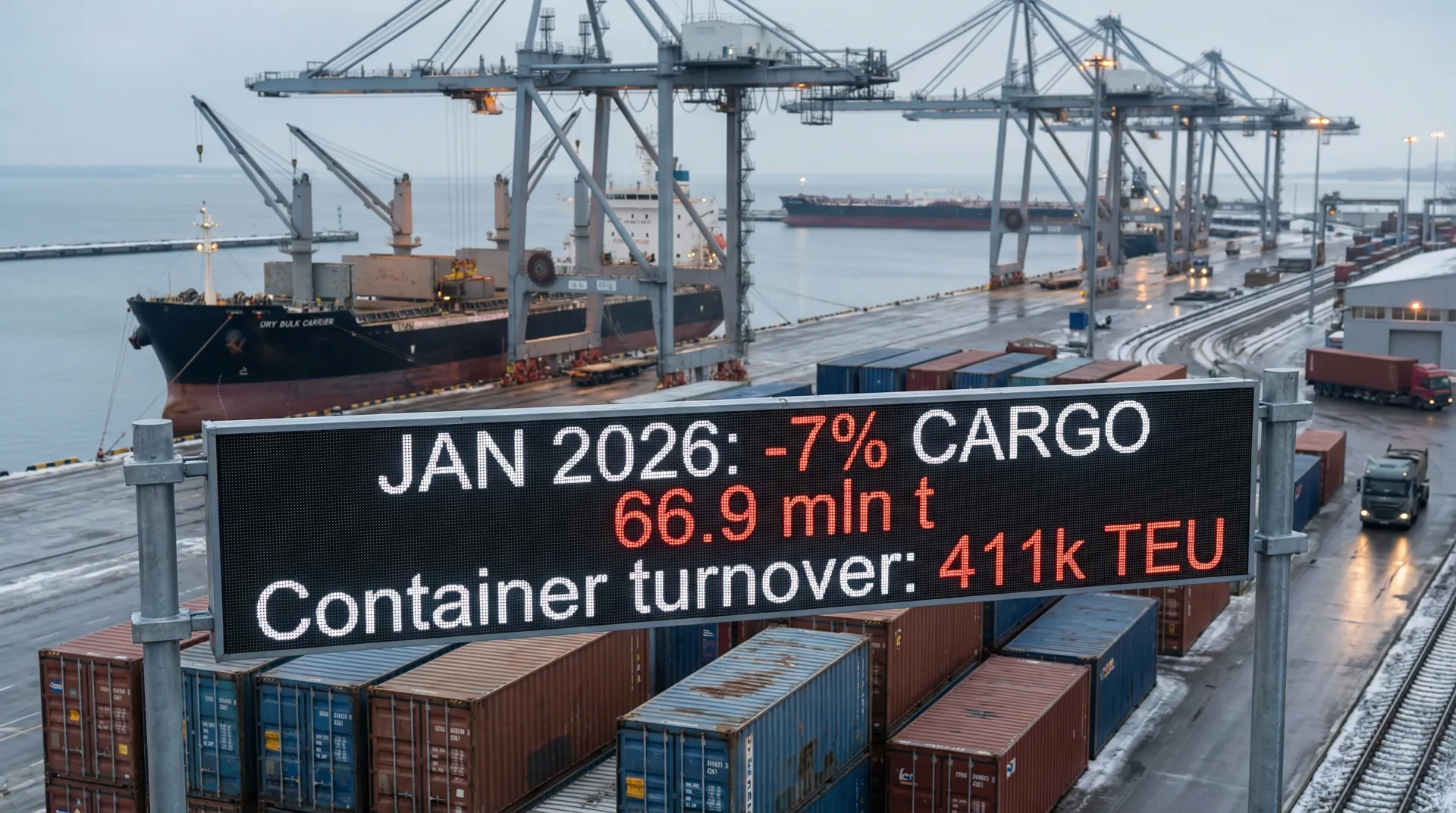
Cargo turnover at Russian seaports in January 2026 decreased by 7% year—on-year to 66.9 million tons, according to the Association of Commercial Seaports. The decline does not look "uniform": dry cargoes sank more than bulk cargoes, and in terms of basins, the south actually "turned over" the picture.
The structure of the fall. Transshipment of dry cargo amounted to 31.0 million tons (-10.4%), bulk cargo — 35.9 million tons (-3.8%). Within the dry nomenclature, mass export goods are most noticeably declining: coal 13.6 million tons (-11.2%), grain 3.4 million tons (-14.5%), cargo in containers 4.1 million tons (-10.9%), ferrous metals 1.7 million tons (-20.9%). At the same time, there are "islands of growth" — ore (+7%) and ferry cargo (+37.9%).
The picture for liquid products is mixed: oil increased (+1.4%) to 21.5 million tons, but petroleum products fell (-10.9%) to 10.4 million tons.
Geography: the main sinkhole is the Azov-Black Sea basin. The Baltic Sea is almost "flat" — 23.3 million tons (-1.7%), the Far East is in the black — 18.9 million tons (+4%), the Arctic added 8.2 million tons (+9.8%), and the Caspian Sea — 0.5 million tons (-26.6%). But the key factor in the overall drawdown is the Azov—Black Sea basin: 16.0 million tons (-26.7%), where both dry and liquid fall. This is an important signal for the market: even with the stability of the "system as a whole", one pool can pull the indicator down — and with it the demand for the fleet, wagons, freight shoulders, and the operation of port warehouses.
Containers: drop faster than a ton. According to InfraNews with reference to JSC "Morcenter", the container turnover of ports in January 2026 amounted to 411 thousand TEU, which is 14% less year-on-year (minus 65 thousand TEU). The Baltic Region sank the most — 117,000. TEU (-25%), Far East — 195 thousand. TEU (-5%), Azov-Black Sea — 85 thousand. TEU (-15%); only the Arctic is in the black — about 14 thousand. TEU (+9%).
In terms of directions, one nuance is indicative: only cabotage is in the black — 101.6 thousand. TEU (+19%), while exports fell by 26% to 134 thousand TEU, imports — by 15% to 175 thousand TEU.
What this means for the business of foreign economic activity and logistics.
- If "containers fall faster than a ton," competition for the cargo base increases and the issue of tariffs and schedules on lines/feeders becomes more acute.
- The shift towards cabotage with weak exports/imports increases the role of internal resale: warehouses at ports, railway shoulders, and auto transportation are becoming the key to maintaining margins.
- The multidirectional nature of the basins means that the "one universal route" strategy will lose: those who quickly redistribute flows between the Baltic, the Far East and the Arctic will win, without losing manageability of deadlines.