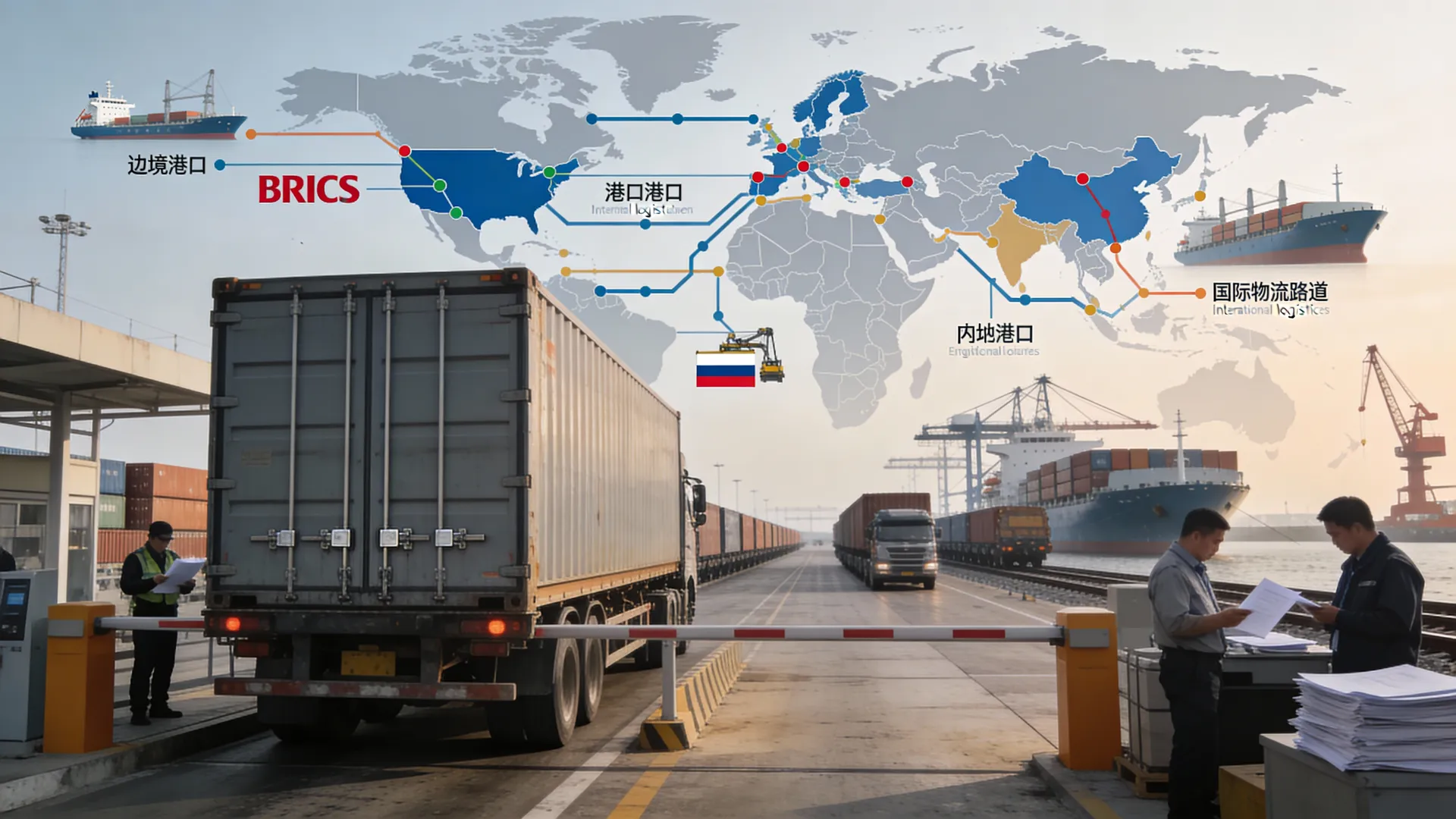
The North—South corridor has gained 26.9 million tons: why the southern route is becoming the backbone of Russia's foreign economic activity

Plans to increase capacity to 30 million tons by 2030 and 35 million tons by 2035 are also found in relevant reports documenting the parameters of the "government plans".
The thesis of a decline in East-west transit after the peak of 2021 is confirmed by international surveys: after 2021, the share/volume of rail China–Europe decreased, with a partial recovery later.
Southern vector: why the North—South route has ceased to be a backup route
Increasingly, the market lives not in the logic of "finding a way around", but in the logic of route risk management. The East—West corridor after 2021 has shown that even a strong infrastructure does not guarantee stability: geopolitics, insurance, sanctions contours, changes in demand and rules at borders can reshape the transit economy in a season. Against this background, North—South for the first time looks not like a beautiful project, but like the architecture of a new foreign trade: it connects Russian industry and agricultural exports with Iran, India and markets further down the chain — from the Persian Gulf to East Africa.
The key signal is in numbers: according to estimates by the Ministry of Transport and the Directorate of corridors, the total freight traffic along the MTK increased from 16.3 million tons (2021) to 26.9 million tons (2024), and in the railway part — over 12.9 million tons. This is important not only in volume, but also in pace: an increase of tens of percent per year means that market participants have already "voted in rubles" and started transferring flows.
Why the Eastern branch has become more practical for business
The Eastern branch (Russia—Kazakhstan—Turkmenistan—Iran) came to business because of its manageability: less dependence on narrow European regulatory zones and more opportunities to "assemble" a multimodal scheme for a specific cargo. At the same time, the real throughput depends on the synchronization of four countries — schedules, windows at the junctions, transshipment and uniform rules for processing documents. Hence the main paradox of the corridor: its growth is ensured not only by government policy, but also by the quality of operational interaction between private carriers, forwarders, ports and terminals.
Bottlenecks that will decide the fate of the corridor
- The Caspian Sea is like a bottleneck. The ferry/ro-ro and the port infrastructure determine whether the route will be “fast“ or "cheap but long".
- Digital connectivity. Without seamless EDO, the corridor loses time: each manual border adjustment adds days, not hours.
- Cargo balance. Exports along the corridor dominate; in order for tariffs to be sustainable, the market needs an increase in return shipments and clear financial settlement schemes.
What does this change for foreign economic activity right now?
For companies, the southern vector foreign economic activity is not a call to "move everyone", but a task of diversification: it makes sense to transfer part of the nomenclature and part of the geography to the North—South as a safety net. Practical gains will be made by those who:
- in advance, he will “decompose” the chain into nodes (railway shoulder, port, ferry, Iranian railway, then the sea/car),
- will prepare documents for multimodality,
- It will include deadlines and responsibilities at the junctions of the route in the contract.
To summarize: North—South becomes the main axis not because it is ideal, but because it gives businesses what they lack in the usual directions — variability and manageability.