A new tax outline is being drawn up around cross-border e-commerce in Russia: deputies and relevant departments are publicly discussing the introduction of VAT on imported goods sold by foreign sellers through marketplaces. The essence of the dispute now is not in the principle itself (it has already been supported by the Duma committee), but in the speed and format of the launch: either immediately "full rate" or soft acceleration for several years.
Today, parcels "for personal use" within the established threshold (up to 200 euros and up to 31 kg) actually fall into a different regime than classic imports, which pass through the importer with VAT, duties and compliance with all turnover requirements. It is this gap that is called a systemic problem: the same product ends up on the market with different fiscal burdens, and this creates a price bias in favor of cross—border supplies.
Two scenarios have become fixed in the discussion:
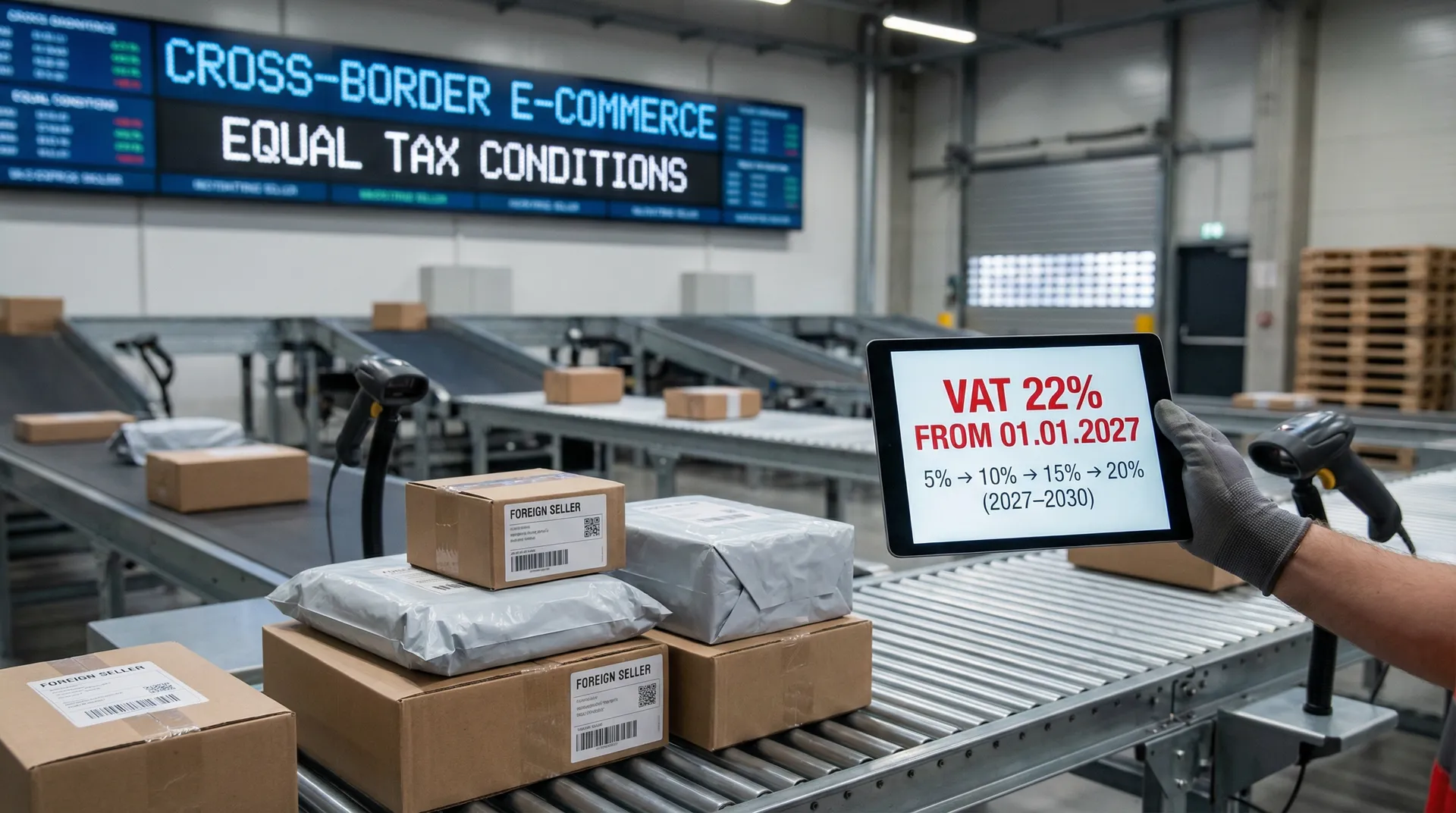
- Option 1 (hard): apply a full 22% VAT on foreign goods on marketplaces from January 1, 2027.
- Option 2 (smooth): a project of the Ministry of Finance with a phased increase: 5% (2027), 10% (2028), 15% (2029), 20% ( from 2030).
It is important to note that the initiative is based not only on the budget, but also on competitive conditions for local businesses and manufacturers. The departmental motive is formulated as directly as possible — about "leveling the rules of the game":
"... the ministry is working on various options to "establish more fair conditions" for Russian and foreign sellers..."
What does this change for the foreign economic activity and logistics market?
For importers and Russian sellers, this is a potential removal of price pressure from the "gray legal" channel, where the product enters as a set of individual purchases. If VAT is indeed levied on cross-border sales by foreign sellers, the price gap will narrow, and the "cheaper because tax-free" model will begin to deflate.
A new area of responsibility is emerging for marketplaces: platforms will need stricter identification of the seller and the origin of the goods, as well as the correct configuration of the tax function (who calculates and who pays). At the same time, the agenda includes the "adjustment" of cross—border trade and the discussion of commissions so that the mechanics do not encourage departure to a foreign circuit.
The consequences for logistics and 3PL will be expressed in the redistribution of flows: with an increase in the final price, part of the demand may go to local stocks (FBS/FBW), and the role of consolidation, customs compliance and digital shipment data will increase in the cross-border segment. In a "smooth" scenario, the market will receive 2-3 years of adaptation; in a "hard" scenario, restructuring may be abrupt as early as 2027.
The main thing that needs to be taken into account right now is that discussions are underway at the level of committees and ministries, which means that businesses should include two modes in the model — fast (22% at once) and stepwise (5→20%). The difference between them is not only the price for the buyer, but also the speed with which marketplaces and loggers will be forced to rebuild processes.