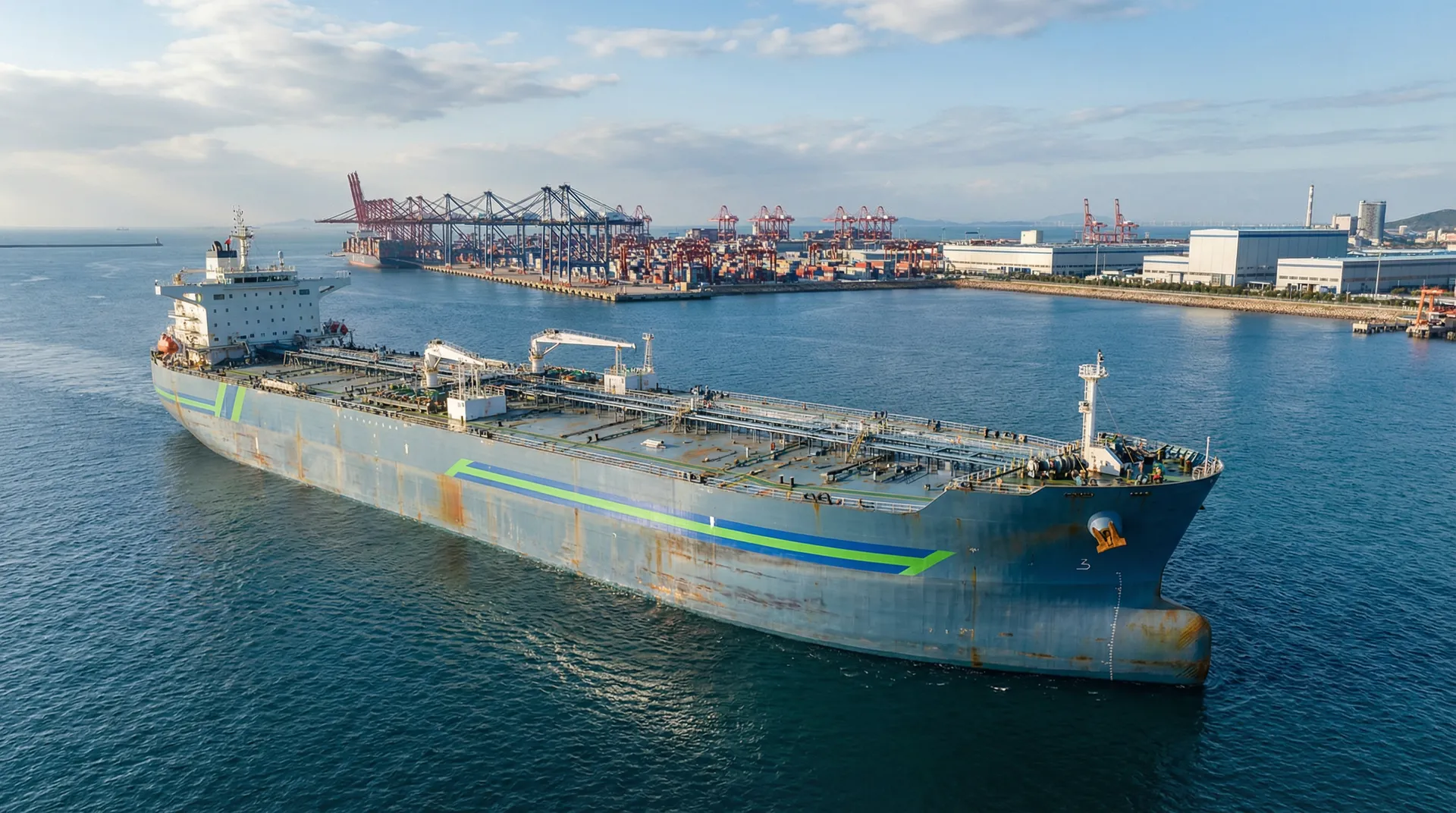
China has taken another technological step in the transformation of global maritime logistics by commissioning the world's first ultra-large oil supertanker powered by methanol and equipped with an intelligent control system. The vessel was successfully launched in the port city of Dalian and is already being considered as a new milestone in the development of environmentally sustainable offshore oil transportation.
The 333-meter-long supertanker is capable of carrying about 2.1 million barrels of crude oil. In terms of its dimensions and load capacity, it corresponds to the VLCC class and is focused on servicing one of the key energy routes — the Middle East – the Far East. It is this corridor that remains critically important for the global oil market, and its decarbonization is becoming a priority for shipping powers.
A key feature of the vessel is a dual-fuel power plant, which allows the use of methanol along with traditional fuel. This approach significantly reduces the environmental burden. According to the developers, carbon dioxide emissions are reduced by 92 percent compared to conventional oil tankers, and sulfur oxide emissions by 99 percent. This is especially important against the background of stricter international requirements for shipping and the climate agenda promoted by the International Maritime Organization.
The intelligent ship management platform deserves special attention. It analyzes the operation of the power plant, navigation parameters and operational loads in real time, automatically optimizing fuel consumption, route and operating modes of the equipment. Such a system increases not only the efficiency of flights, but also the safety of operation, reducing the risk of accidents and emergencies during long crossings.
In fact, we are talking about a new generation of "smart" tankers, where digitalization becomes not an auxiliary, but a basic function of the vessel. Experts note that such decisions can significantly change the economics of oil transportation by sea, especially on long-distance routes with high fuel costs and strict environmental requirements.
The design and construction of the supertanker was carried out entirely by Chinese engineers, which underlines the PRC's desire to take a leading position in the segment of high-tech and environmentally friendly shipbuilding. China has consistently invested in the development of alternative marine fuels, considering methanol as one of the most promising transitional options on the way to reducing the carbon footprint of global logistics.
The launch of such a vessel strengthens China's position not only as the largest participant in world trade, but also as a technological legislator in the field of maritime cargo transportation. In the future, similar solutions can be scaled to other types of vessels, including container ships and bulk carriers, which will have a direct impact on global supply chains and international energy trade.