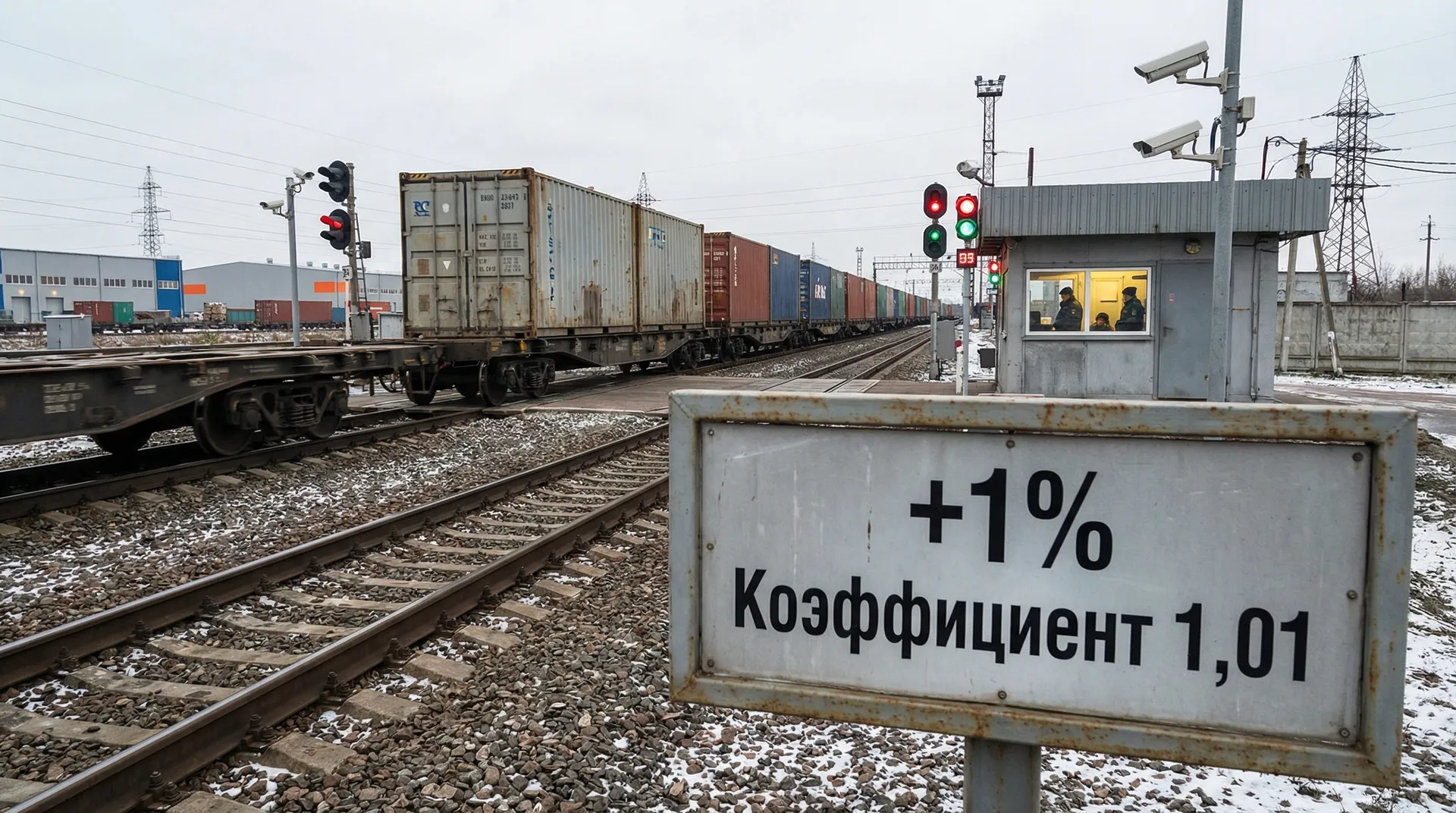
The Federal Antimonopoly Service has approved a temporary surcharge to the freight railway tariff: from March 1, 2026 to February 28, 2027, an additional coefficient of 1.01 is applied to tariffs, which is equivalent to an increase of about 1%. Formally, the decision is presented as a targeted one: the funds should cover the costs of strengthening transport security on the railway.
"In order to finance measures to ensure safety in railway transport, the government of the Russian Federation has decided to establish an additional coefficient of 1.01 to freight tariffs from March 1, 2026 to February 28, 2027. In pursuance of the relevant decision, the FAS of Russia has developed and approved the order."
For cargo owners and forwarders, this looks like "plus 1% to the cost of the shoulder," but the real effect is broader. Railway logistics is often based on long tariff schedules, where 1% head-on may not be critical, but it becomes important for large volumes and long contracts: metallurgy, coal, fertilizers, container flows. Any change in the coefficients is automatically reflected in calculations, rate revisions, contract indexing and, ultimately, in the price for the end customer, especially in segments with low margins.
Russian Railways explains the surcharge as financing additional transport security measures, including protection against acts of unlawful interference, and indicates that the proceeds will be used for activities at more than 1,000 transport infrastructure facilities. This is an important detail: businesses are actually offered an "insurance premium" to reduce the risks of disruption of transportation and incidents on the network.
Context matters too. In recent years, the railway has been under simultaneous pressure in terms of capacity, cost of infrastructure projects, and safety requirements. Against this background, "point" coefficients become a tool for quickly raising money without completely revising the tariff. For foreign economic activity and transit chains, this means one thing: when planning supplies for 2026-2027, it is worthwhile to lay down tariff amendments in advance, prescribe a clear recalculation mechanism in contracts, and separately monitor how the surcharge affects multimodal routes, where railway leverage is associated with ports, terminals, and road delivery.