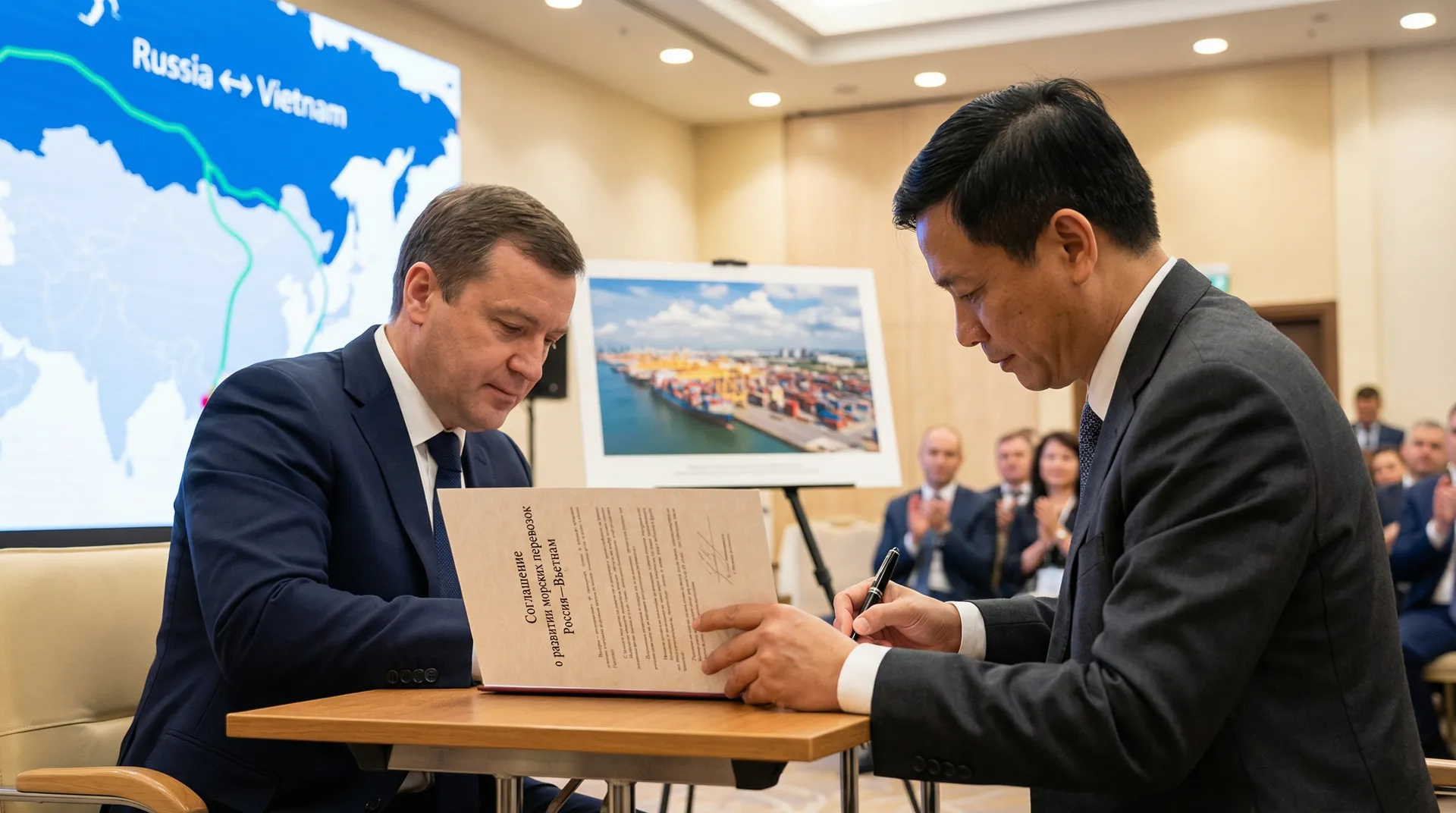
An agreement was signed at the Vietnam-Russia business forum, which strengthens the maritime logistics vector between Russia and Vietnam. Delo Group of Companies, a Russian transport and logistics holding, and Vietnam Maritime Corporation (VIMC) have registered their intention to develop maritime transportation and joint projects in the transport infrastructure. The document was signed by Andrey Sokolov, Deputy Director General for Government Relations at Delo Management Company, and Le Quang Trang, Vice President of VIMC.
The key quote from the parties' message describes the subject of cooperation as directly as possible:
"Delo Group of Companies and Vietnam's largest logistics state corporation, Vietnam Maritime Corporation (VIMC), have signed an agreement aimed at developing maritime transportation between our countries."
This news is important for the market in two ways. The first is the regularity and predictability of maritime services in the Asian direction. When transportation between countries develops through a combination of a large holding company and a state-owned logistics structure, cargo owners have a better chance of obtaining stable shipping windows, understandable processing conditions and consistent rules for interacting with the port infrastructure.
The second line is infrastructural. The agreement indicates a willingness to work on projects to develop transport infrastructure in Vietnam and expand the range of services on the international market. In such designs, marine logistics ceases to be just a “transportation line” and becomes a system where the quality of port connections, service around the container, storage, clearance, and multimodal crossings are important.
It was also noted that the agreements were the result of negotiations initiated last year by Sergey Shishkarev, Chairman of the group's Board of Directors. This shows that the project was planned in advance and is likely to develop in stages through specific services and routes.
The practical conclusion for the foreign economic activity teams is that it is worth carefully monitoring what routes and conditions will be offered within the framework of cooperation. For exporters and importers on the Russia—Vietnam route, such agreements often lead to an expansion of the portfolio of options by sea and to the emergence of new “entry points” where the supply chain can be reassembled to meet deadlines and costs.