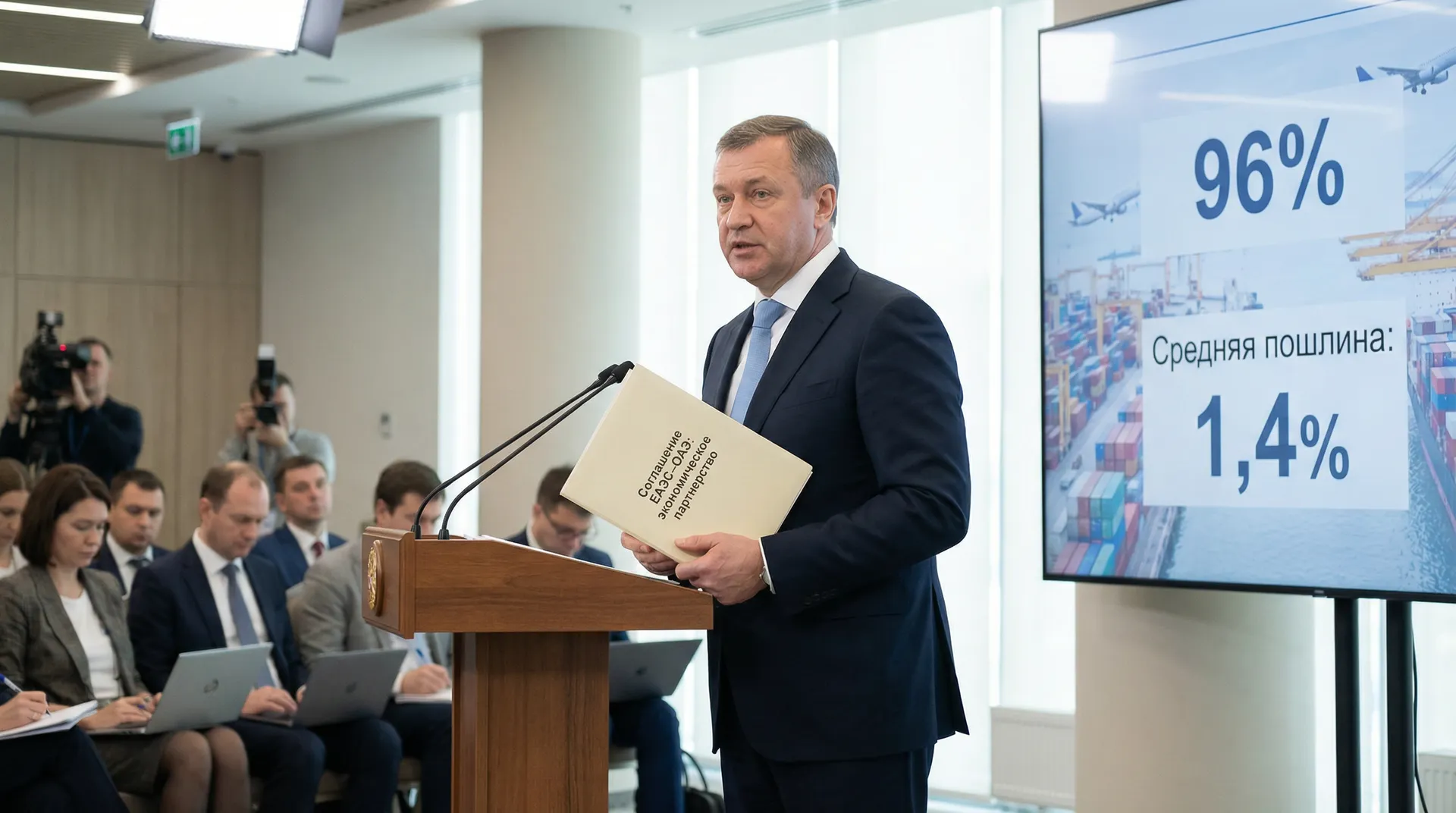
The Russian government has approved the submission to the State Duma of documents for the ratification of the agreement on economic partnership between the EAEU and the UAE. In the logic of foreign trade, this is a transition from negotiations to a regime that changes the calculation of duties and conditions of market access for a wide range of commodity items.
The key parameter that a business will measure with money is the coverage of preferences. According to the data provided, preferential treatment applies to 96% of Russian exports. The average rate of duties on Russian products should be reduced by more than three times: from 4.7% to 1.4%. For shipments from the UAE to the EAEU, the average duty rate is also reduced: from 6.6% to 1.5%.
The list of product groups, where the duty is declared zero for most categories, includes poultry meat, fish, dairy products, sunflower oil, fertilizers, ferrous metal products, mechanical machinery and equipment, as well as motor vehicles. For companies, this has a direct impact on shelf price, margin, and competitiveness in tenders and long-term supply contracts.
It is also important that the effect is visible in logistics. Reducing duties reduces the final customs burden, simplifies batch planning, and reduces the cost of routing errors through UAE hubs. This gives exporters more room to play with carrier tariffs, insurance and warehousing services, when the final cost price in the Persian Gulf market depends on the choice of a corridor.
The expected economic effect is formulated through an assessment of direct savings. Maxim Reshetnikov has identified a landmark:
"Thanks to the implementation of the agreement, Russian businesses will be able to save up to 9 billion rubles a year."
For participants of foreign economic activity, preparation for the new regime begins long before the "X" day. You will have to check the HS codes for key items in advance, the requirements for proof of origin, the chain of documents and the pricing model in the contracts. After ratification, it is these details that will determine who will quickly take away the effect in the form of reduced duties, and who will run into classification errors and additional charges.