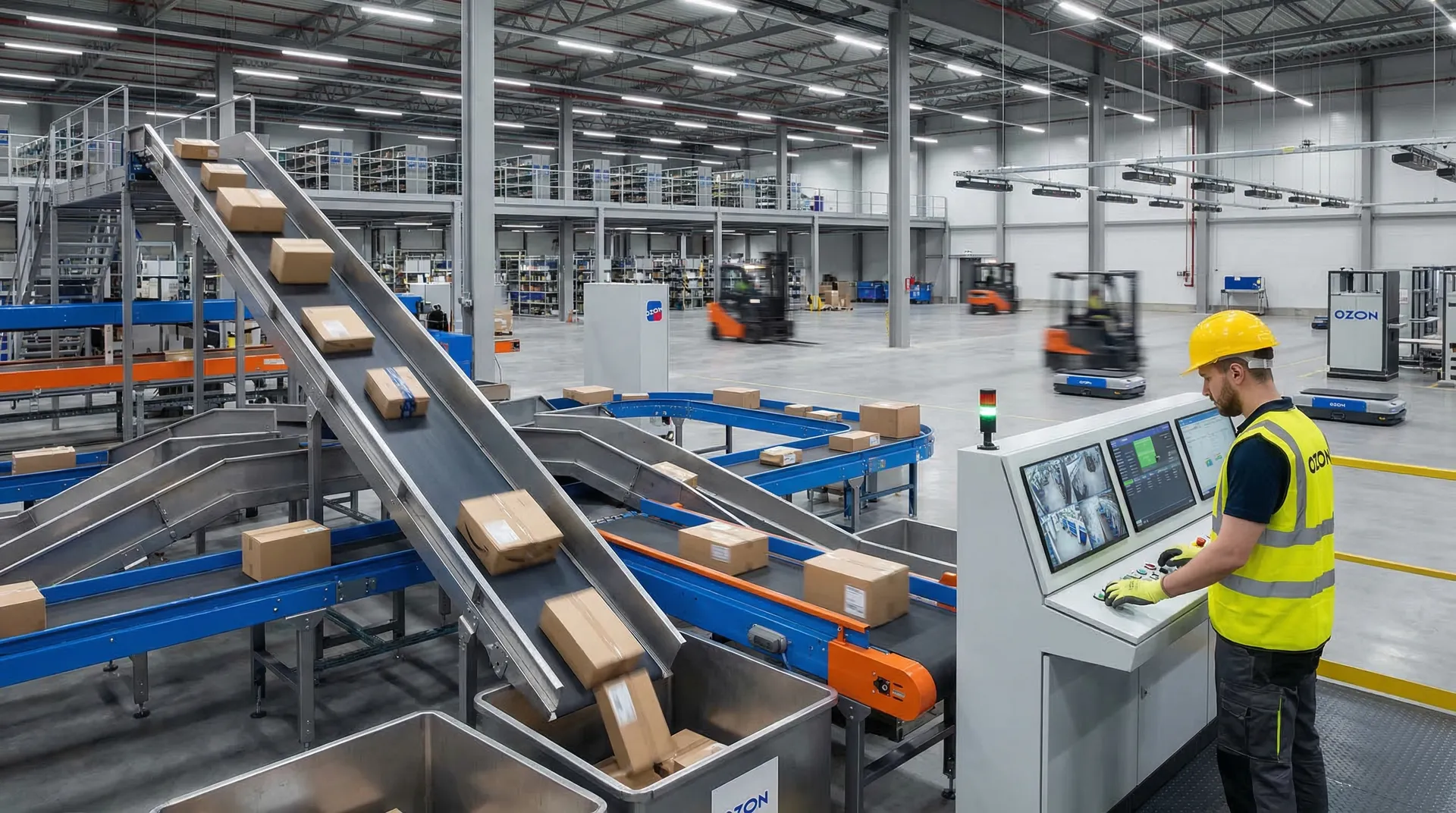
In 2026, Ozon is betting on accelerating warehouse automation and announces plans to increase the number of automated processes in logistics by eight times. The company attributes this step to the growth of its own infrastructure and the pace of online orders, which is already changing the requirements for processing speed in the fulfillment.
A key element of the program is the scaling of 3D sorters and devices that reduce manual labor in measuring and sorting. In 2025, such solutions were tested in warehouses: 3D sorting and contactless measurement of the dimensions and weight of bulky goods in seconds. In 2026, the company plans to increase the number of 3D sorters to more than 330, while 30 were installed in 2025.
The technical parameters look like a response to the bottleneck of the market — the sorting speed. One 3D sorter is capable of serving up to 600 destinations and processing up to 10,000 parcels per hour. Ozon expects that this will increase sorting productivity by three times and bring the share of automated sorting processes to 90% through solutions for oversized and packaged goods in about 100 areas.
At the same time, the company is investing in its own production of conveyor solutions. Ozon Tech is assembling conveyors for logistics centers at the robotics laboratory in Innopolis and says that in 2026 it intends to cover the production and installation needs on its own.
An important part of the news is personnel. Automation is changing the structure of warehouse personnel: there is less need for manual operations and higher demand for engineers and technicians. Anton Stepanenko, Technical Director of Ozon, explained this through the effect of his own WMS:
"It includes inventory, accounting of receipts and shipments of goods, planning routes for the movement of goods inside the warehouse. Thanks to it, it is possible to reduce the number of employees by 20-30% in the administrative and logistics departments of the warehouse."
The company has the base to digest such changes: in 2025, the area of the logistics infrastructure exceeded 5 million square meters. It includes 51 fulfillment centers and more than 150 delivery hubs across the country. 80% more operations are performed at logistics facilities than a year ago (55 million), and more than 23 million shipments are delivered daily.
For the e-commerce market, this sets a new "norm": those who do not speed up sorting and internal transportation begin to lose out in terms of time and cost. For carriers and 3PL, this is a signal to prepare compatible data interfaces and tougher SLAs for peaks, because the speed of the warehouse becomes equal to the speed of the entire chain.