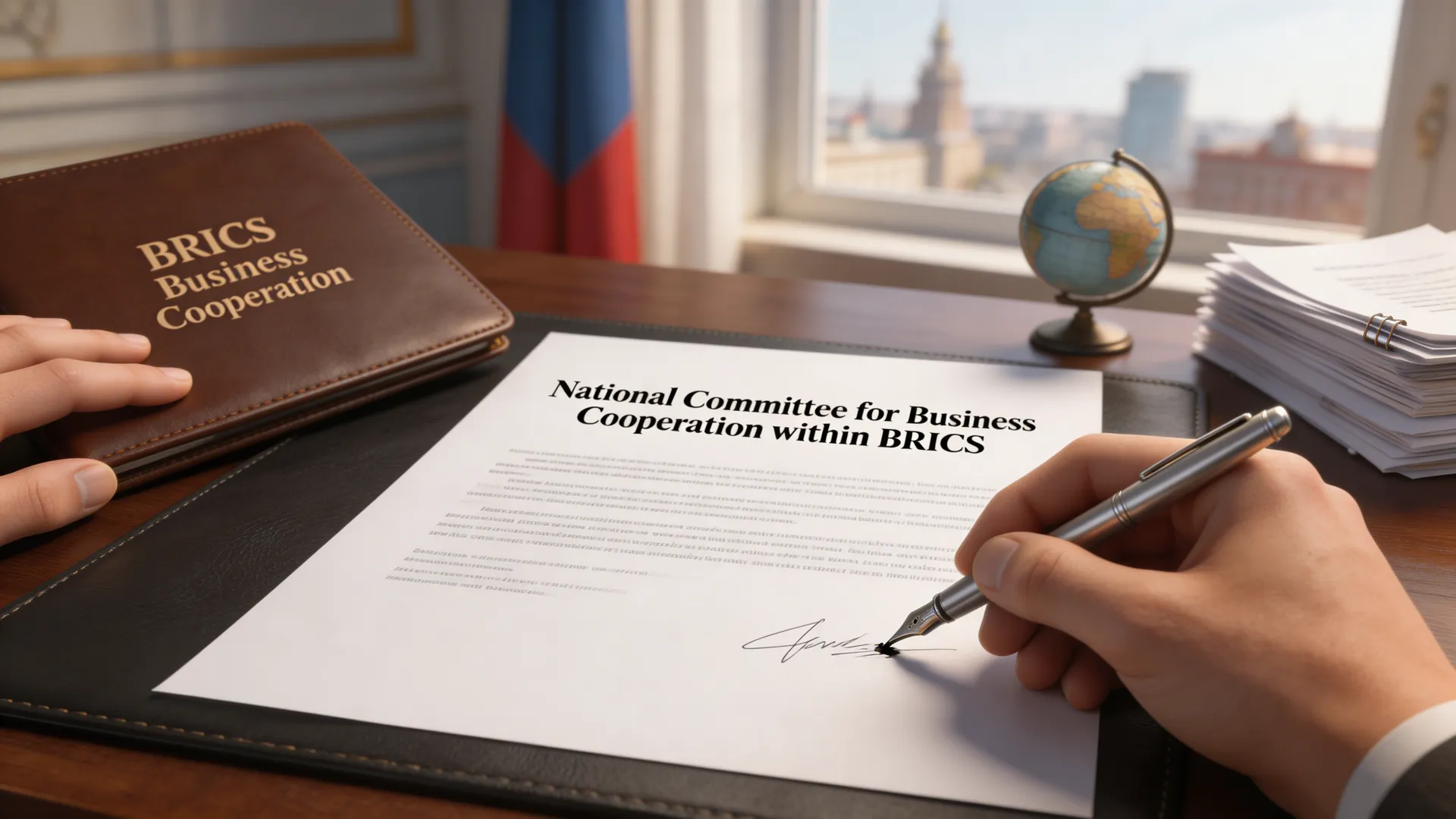
Russia is formalizing the BRICS "business contour": President Vladimir Putin has signed an order to establish a National Committee for Business Cooperation within the framework of the association. This step is not about declarations, but about manageability — when foreign economic projects run into approvals, industry regulations, currency restrictions, logistical bottlenecks and the gap between the request of companies and the response rate of departments.
The essence of the new body is to become a "junction" between the business community and federal executive authorities that are involved in the development of multilateral and bilateral cooperation between Russia and the BRICS. In the wording that has spread across the tapes, the key legal emphasis is as follows:
"To form a National Committee for Business Cooperation within the framework of the BRICS association."
Maxim Oreshkin, Deputy Head of the Presidential Administration, was appointed Chairman. At the same time, the management timing also sets the order: the chairman will have to approve the composition of the committee within the prescribed period.
Why it's important right now. BRICS is simultaneously expanding and becoming more complex: more countries — more different trade regimes, currency rules, certification standards, compliance requirements and logistics models. For companies, this turns into "hidden costs": the project seems to be economically profitable, but it gets stuck on approvals, the inability to quickly confirm the origin of the goods, payment restrictions, discrepancies in technical regulations and supply insurance.
The Committee is stated as a tool that will not just "collect business opinions", but prepare proposals on areas of cooperation in the logic of the BRICS Business Council and formulate proposals for the president and the government on the development of business cooperation. In practice, this can have three effects for foreign economic activity and freight transportation:
- Reducing the bureaucratic distance is when a business has a clear channel for escalating problems "up" without spreading them across departments.
- Packaging projects for cross—country formats - industrial cooperation, localization, investment projects, logistics hubs and corridors require a "single window" on the government's side.
- Rules are predictable for friendly markets, especially where settlements and logistics are sensitive to sanctions pressure and secondary risks.
It is important to soberly assess the limitations: By itself, the committee will not replace the banking infrastructure, insurance, reinsurance and transport "physics". But it can accelerate decision—making that transforms the BRICS policy framework into an applied set of mechanisms for companies, from removing regulatory blocks to supporting large cooperative chains.