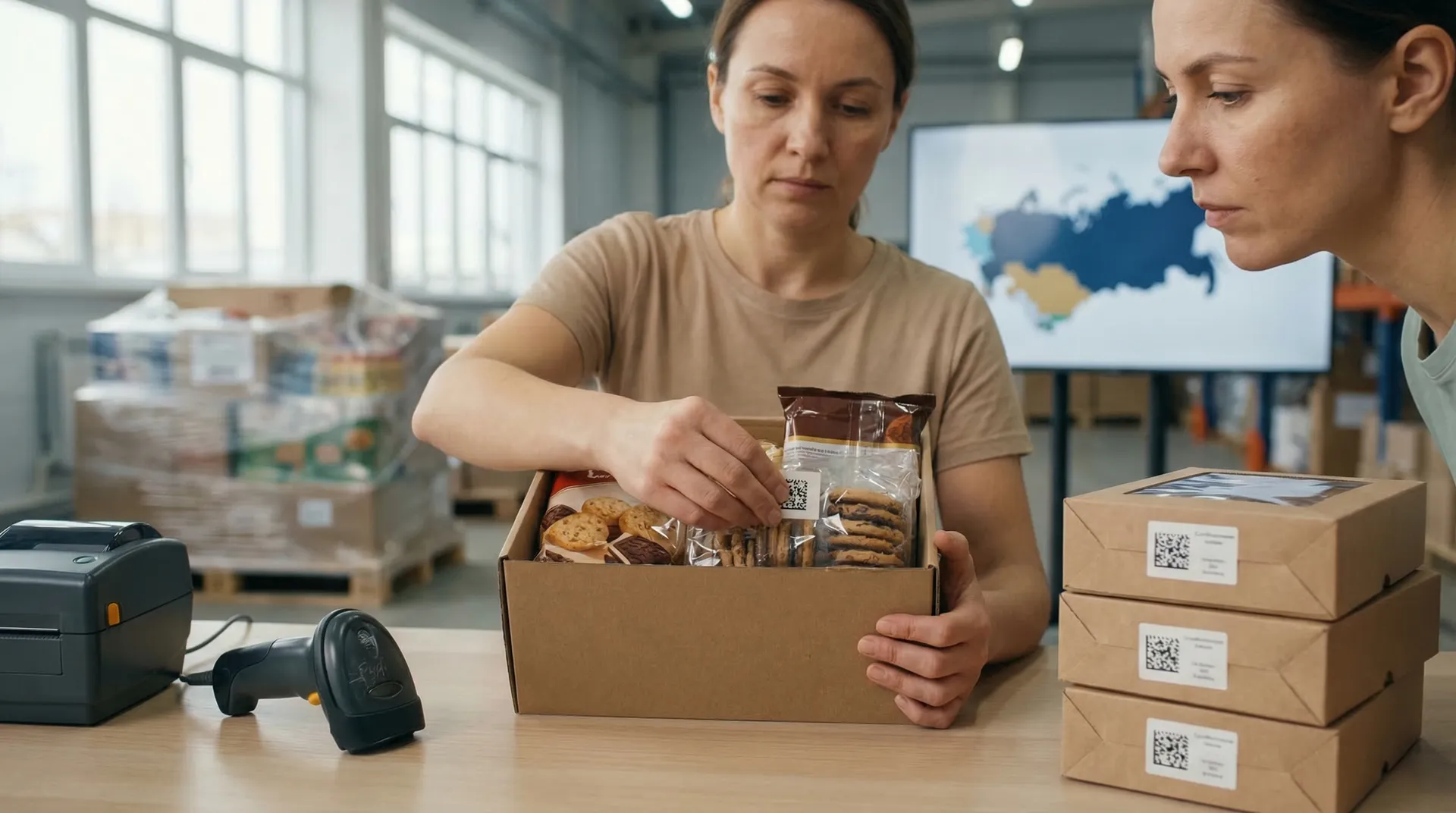
At a meeting on March 13, 2026, the Council of the Eurasian Economic Commission approved uniform labeling requirements for certain types of confectionery products in consumer packaging. The solution closes a long-standing practical problem for suppliers who work in several EAEU markets at once: when the rules and code formats differ, the goods at the border actually "lose speed" and turn into a project to finalize packaging, documents and warehouse operations.
The key point of the new approach is that countries are moving towards a common framework. The official explanation is underlined:
"Labeling will be carried out according to unified rules in accordance with the basic model of labeling goods in the EAEU approved in 2019."
For foreign economic activity, this means a more predictable supply chain. If the code is applied according to general requirements, it must be "readable" and recognized throughout the union. In the commentary to the solution, this effect is stated directly:
"Thus, mutual recognition of codes will be ensured, which will eliminate the need to re-label goods when they are in circulation in the union," he noted."
Practice shows that re-labeling almost always hits three points: expiration date and planning, cost of warehouse work, and the risk of labeling errors. For the confectionery industry, where batches are often divided into different distribution channels and marketplaces, and packaging is "box in box," an extra operation quickly increases costs. The unified standard reduces the number of forks: fewer code options, fewer "manual" approvals with networks and operators, easier to train personnel in warehouses and at 3PL.
However, the launch will not be simultaneous for everyone. Countries were given the right to choose the date and order of implementation, but with a clear rule on communication.:
"At the same time, the states of the Union will independently determine the date of introduction and the procedure for labeling products with means of identification on their territory, notifying the EEC no later than six months before the start of the relevant events."
For market participants, this is a signal to prepare in advance. Exporters and importers should reassemble the SKU card by category, understand which groups fall under the requirements in each country, and agree in advance on exactly where the code will be applied: at the factory, at the contract site, at the customs warehouse, at the fulfillment. A separate integration unit: printing, aggregation, scanning on shipment, data exchange with partners and marketplaces. The sooner the company synchronizes the IT circuit and warehouse processes, the lower the risk of shutdowns during peak seasons.
The decision of the EEC Council sets a common "language" of labeling for confectionery products. For logistics and foreign economic activity, it's about the speed of turnover and reducing operational risks in cross-border chains within the EAEU.