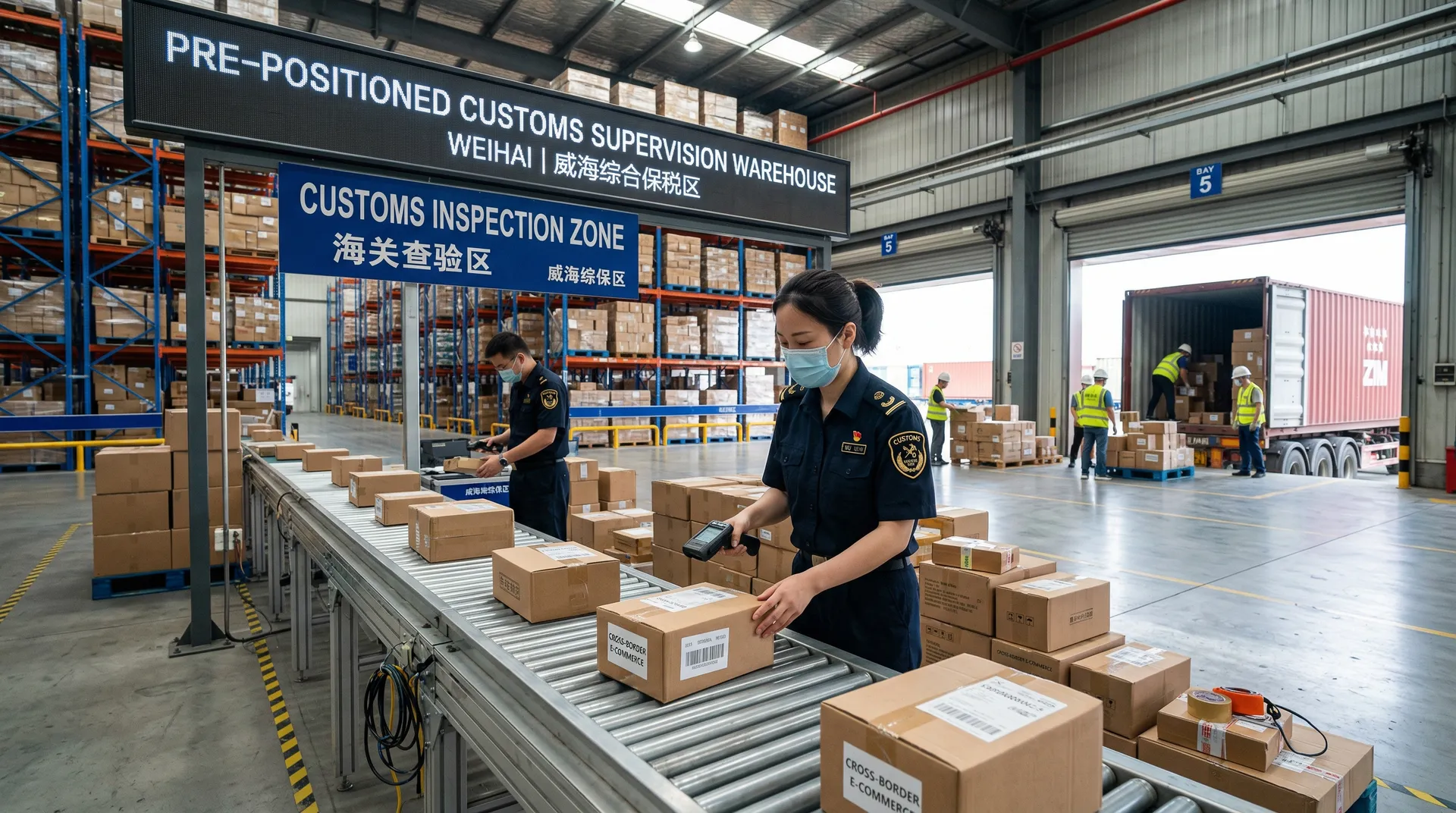
China continues to assemble e-commerce exports into a faster and more manageable loop. The country's first "advanced customs control warehouse" for the retail export of cross-border e-commerce has opened in Weihai City (Shandong). The model is designed so that the customs "node" is transferred inside the company's warehouse: after packing and sorting, the parcel enters the built-in control area, is processed and immediately prepared for shipment without additional transportation to a separate customs facility.
CCTV emphasized a key practical detail: the clearance takes a few seconds, after which the cargo can be immediately consolidated and loaded into a container, and the shipment goes to the international line in the evening of the same day.
The head of the Weihai Customs post (in the CCTV article) explained how the scheme has changed and where time savings arise. Translation of his commentary into Russian:
"Previously, after packing and sorting, companies transported goods to a customs facility for inspection. After the clearance was completed, the cargo had to be reloaded into the container. The Advanced Customs Control Warehouse places the customs site directly in the company's production warehouse, and the company can carry out the declaration, inspection and loading of the container in one place."
According to Chinese sources, the effect of the new scheme is measured by specific metrics: processing is accelerated by about 3 hours, internal logistics costs are reduced by more than 20%, and some shipments are accelerated to a day by eliminating the "extra shoulder" between the warehouse and customs.
For foreign economic activity teams and logistics operators, the meaning of the model is that control ceases to be a separate stage of the route. It becomes part of the production process in the warehouse. This results in a smoother flow, reduces the likelihood of repeated cargo handling, reduces the risk of delays during reloading, and increases the predictability of line entry. At the next stage, such a scheme is planned to be scaled so that enterprises can connect to a single standard "on-site design and release".