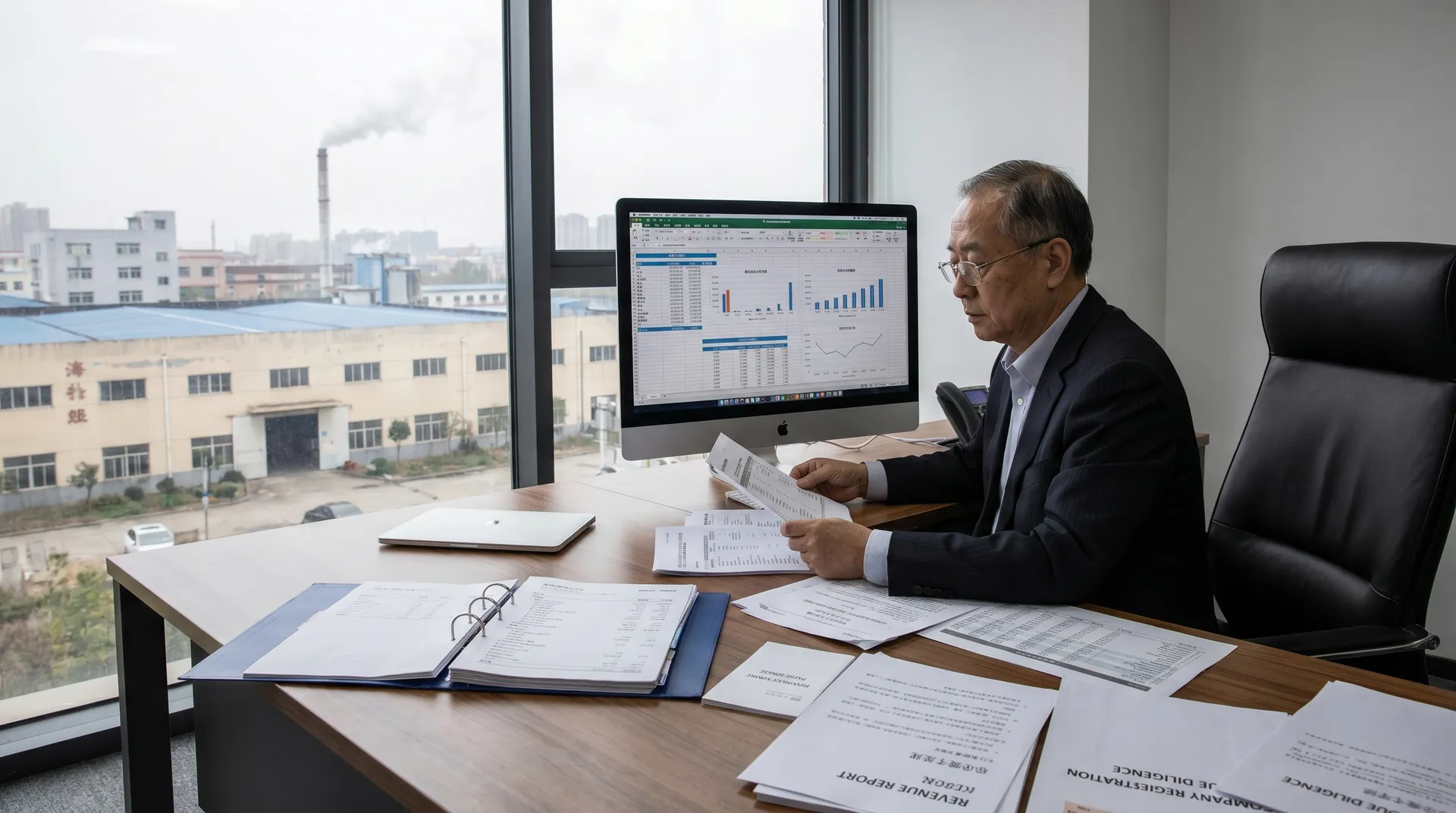
When the initial check showed "clean", but the questions remained
It happens more often than it seems. The company is registered, the status is active, there are no court cases, there are no tax debts, there are stars and reviews on Alibaba. Everything looks right. But something about the counterparty's behavior is alarming.
Here are a few situations that I have encountered in practice that require a deeper analysis.
The counterparty does not match the manufacturer.
You are negotiating with a trading company that positions itself as a manufacturer. When checking the business license, you can see that the field of activity is trade, not production. There are no production assets. The address is an office building in the center of Shanghai, not an industrial area.
This is not necessarily a scam. Resellers in China are a normal practice. But if it is important for you to work directly with the manufacturer (quality control, the possibility of production audit, pricing), you have an intermediary in front of you who has kept silent about this. This affects the contract, the cost, and your position in the dispute.
The authorized capital has been declared, but not paid.
In China, until 2014, there was a system of mandatory payment of the authorized capital upon registration. After the reform, companies were given the right to declare capital without immediate deposit. Technically, this is legal. In fact, a company with a declared capital of 50 million yuan and real assets of several thousand means that it will be extremely difficult to recover anything if a dispute arises.
It is for checking the real financial condition that the commercial services from steps 8-9 are needed: Tianyancha and Qichacha show not only the declared, but also the actually paid-in capital, as well as balance sheet data where they are available.
Related parties and the sanctions context.
This point is becoming more relevant in 2025-2026. Your counterparty is technically clean. But its founder is also a director in eight other companies, one of which appears on the sanctions lists. Or the chain of ownership leads to structures working with sub-sanctioned jurisdictions.
This is not verified in free government databases. To do this, you need Tianyancha or Qichacha — specifically in the "Links between organizations" section. Look at the relationship graphs, not just at the card of a particular company.
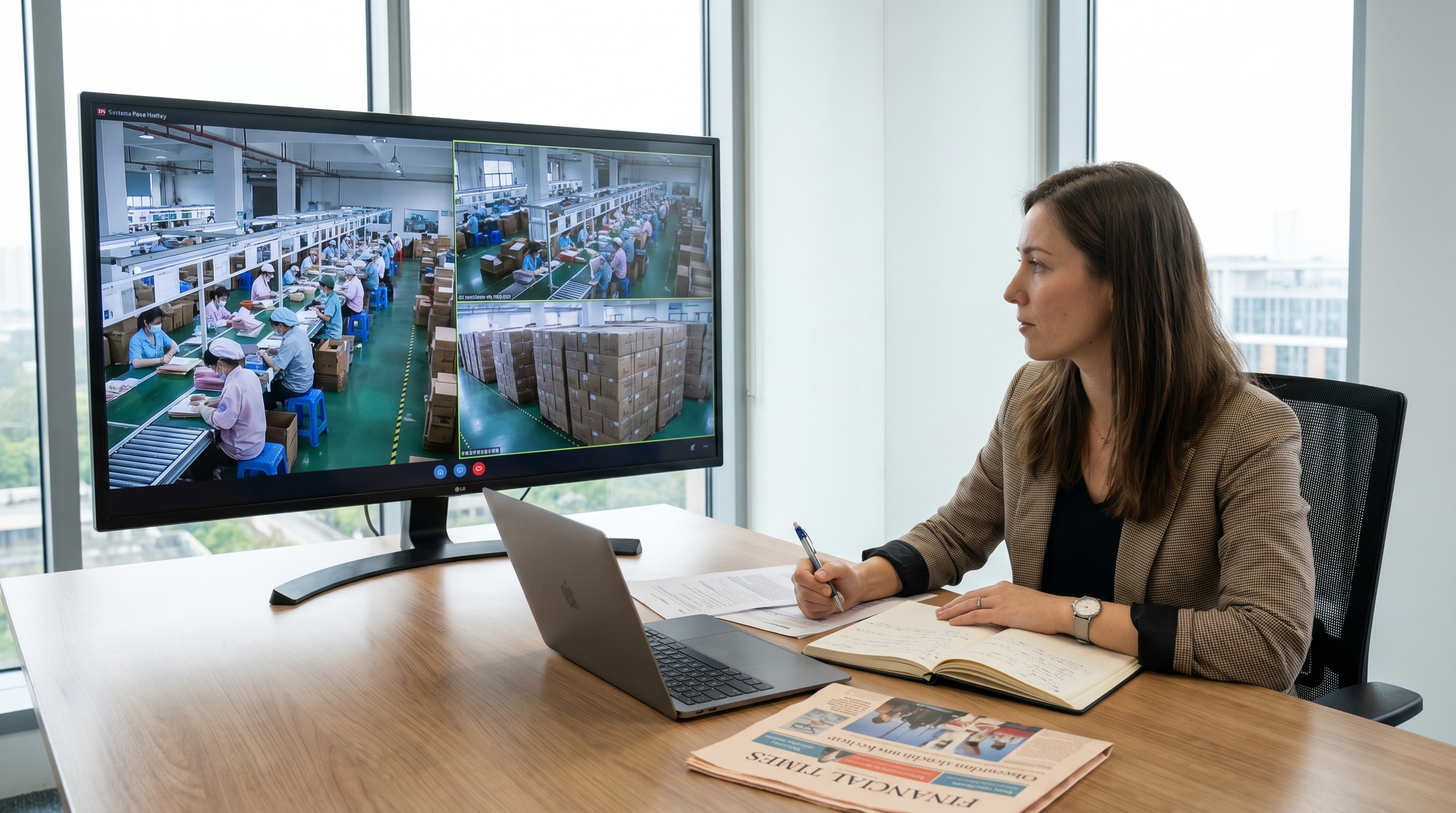
Case study: when everything looked right
The company is a Russian importer of industrial equipment. We found a Chinese supplier through the exhibition, WeChat correspondence, samples were sent quickly, and the quality was satisfactory. A basic check was carried out: the company is registered, active, the register of violations is clean. We signed a contract and transferred an advance payment of 40% of the contract amount.
Three months later, it became clear that the equipment would not be delivered on time. The supplier referred to production problems. The Russian side began to figure it out.
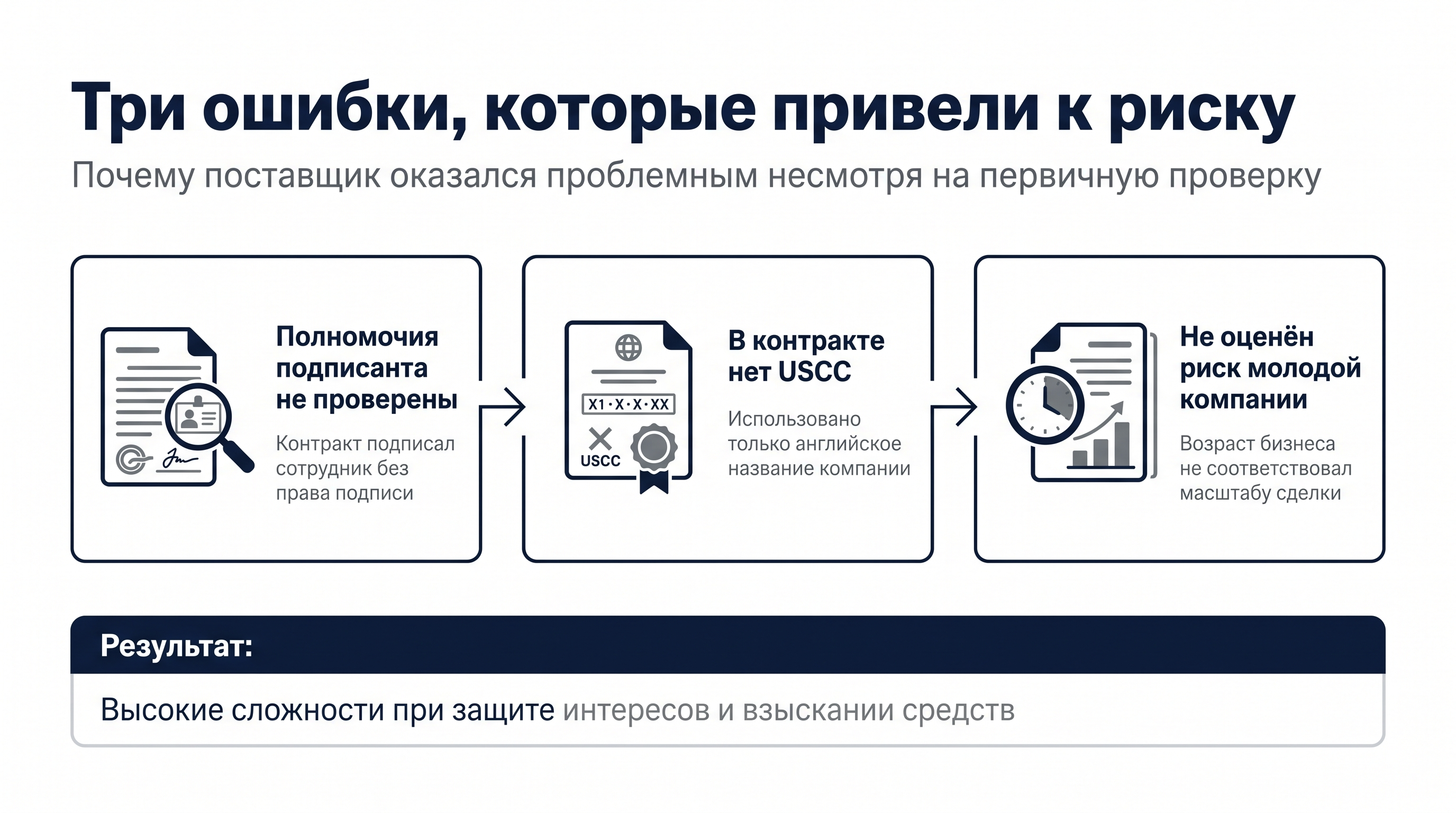
It turned out the following. The company with which the contract was signed is a trading company, registered two years ago. There is no real production. The contract was signed on behalf of the Chinese side by an employee who did not have the authority of a signatory under the charter. The contract specified the English—language name of the company - without the USCC and without the Chinese name.
What this meant practically: it is extremely difficult to file a claim against the Chinese side in a Chinese court, because the person who signed the contract did not have the authority to do so. Foreclosure through a Russian court under such a contract is a lengthy and expensive procedure.
What went wrong at the verification stage:
- The signatory's credentials were not checked. Step 1 of the algorithm — to request a business license and the position of the signatory with the full name in Chinese - was not completed in full. The license was checked, but the credentials of a specific person were not.
- The English name was used in the contract. Without the USCC and the Chinese name, the contract is vulnerable to any dispute.
- We did not check the age of the company in the context of the transaction amount. A two—year-old company with an advance payment of several million rubles. For such a volume, it was worth requesting financial statements or bank guarantees.
What to add to the algorithm for medium and large transactions
An initial check of the nine steps from the first part covers the underlying risks. For transactions starting from a certain amount, I add three more elements.
Verification of the signatory's credentials.
Request the company's articles of association or an extract confirming the authority of a specific person. In China, a legal representative has the right to sign a contract — 法定代表人 ( (fǎdìng dàibiǎorén). This name is specified in the business license. If the contract is signed by another person, there must be a power of attorney issued in accordance with Chinese law.
Verification of bank details.
Before transferring funds, request an official letter with bank details on the company's letterhead with a seal. Check the recipient's name with the Chinese name from the business license. Fraudulent schemes involving the substitution of banking details are one of the most common ways to lose money when working with China. Banking details received only via WeChat, without official confirmation, is a risk.
Physical verification (for large contracts).
If the contract amount is significant and we are talking about a production partnership, verify the actual existence of the production. This can be a field trip organized through a partner in China, or a request for a real-time video production tour. Beautiful photos from the website and exhibition samples do not replace this step.
What exactly is not worth doing
Rely only on recommendations. "This company was recommended to us by a partner" is not a test. Even a bona fide partner might not check the counterparty as thoroughly as your particular transaction needs.
Consider that brand awareness = reliability of a legal entity. A high—profile trade name and the real legal status of a company are two different things. Check the exact legal entity with which you are signing the contract.
Transfer money before the verification is completed. Any normal counterparty will wait for due diligence to be completed. The pressure "transfer now, otherwise you will lose the slot" is a signal, not an argument.
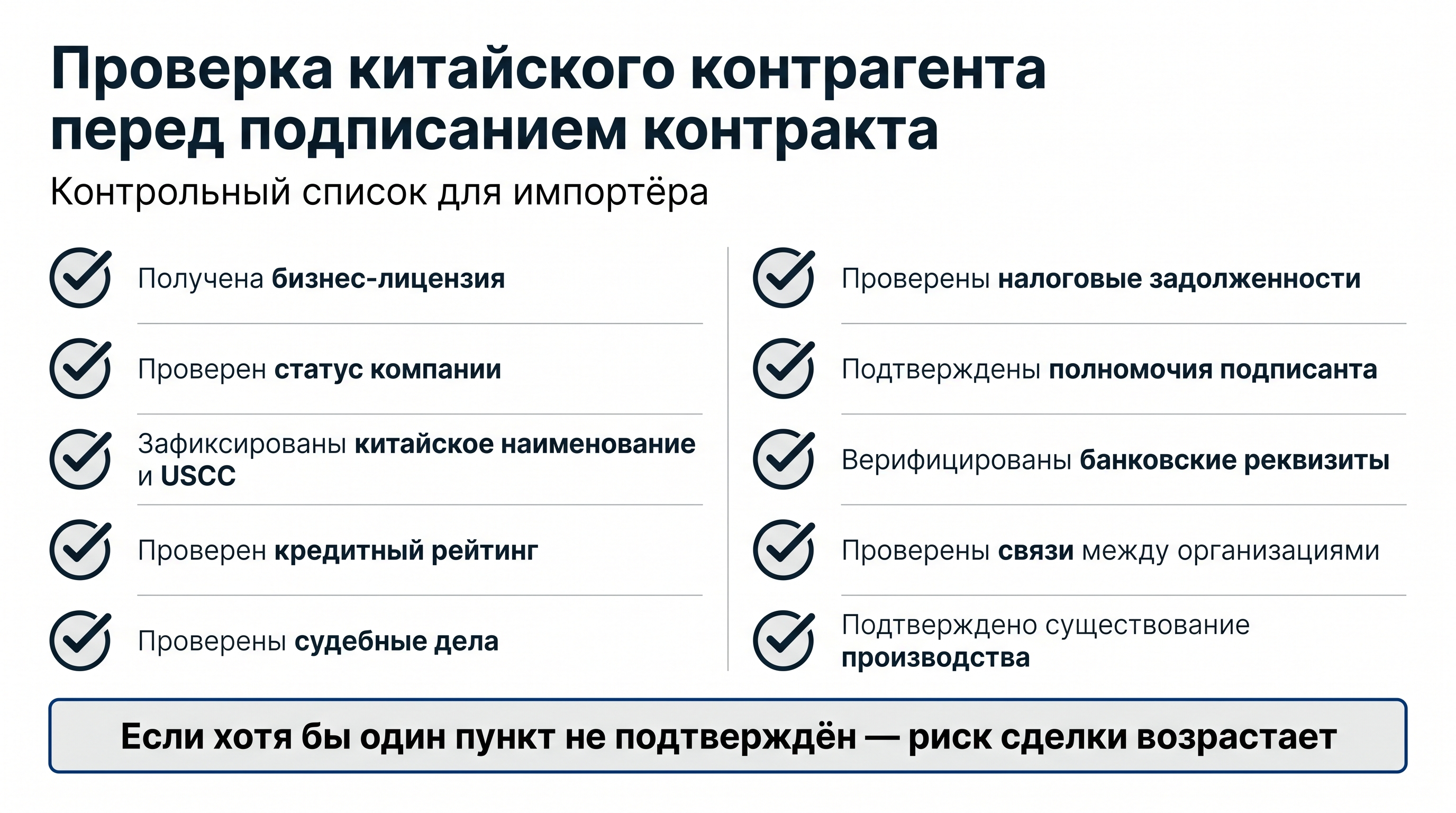
Final checklist before signing the contract
- The business license was obtained and verified through gsxt.gov.cn
- The company's status is Active
- The Chinese name and the USCC are fixed and will be included in the contract.
- The credit rating is verified through creditchina.gov.cn
- Court cases are checked through wenshu.court.gov.cn
- Tax debts are checked through chinatax.gov.cn
- The powers of the signatory are documented
- The bank details are verified on the official letterhead with a seal
- For large transactions, links between organizations are verified through Tianyancha or Qichacha
This is not a bureaucracy. This is a standard of work that saves money and nerves — yours and your clients'.
If you find any alarms during the verification process and want to analyze the situation in detail, please contact us via the consultation form on the portal. I work in conjunction with my legal colleagues, so that a comprehensive assessment of the contract and judicial protection, if necessary, are in one place.