Why are international direct transfers increasingly not working?
The sanctions pressure has changed the behavior of banks around the world. Financial institutions in Europe, the United States, and even in a number of Asian countries have introduced internal compliance filters that automatically delay or block transactions involving Russian legal entities, even when it comes to legal trading.
In practice, it looks like this: the company sends a payment to a supplier in Germany for industrial equipment. The correspondent bank in the Netherlands delays the transfer for verification. After two weeks, the money is returned without explanation. The supplier is waiting. The product is in stock. The contract is under threat.
This is where routes through third—country jurisdictions that maintain normal correspondent relations with both the Russian and Western banking systems come into play.
How does routing payments through third countries work?
The principle is simple: instead of a direct transfer "Russia → recipient's country", the payment goes through an intermediary — a bank or a payment agent in a neutral jurisdiction. The money is converted, the route is changed and sent to the supplier in the required currency.
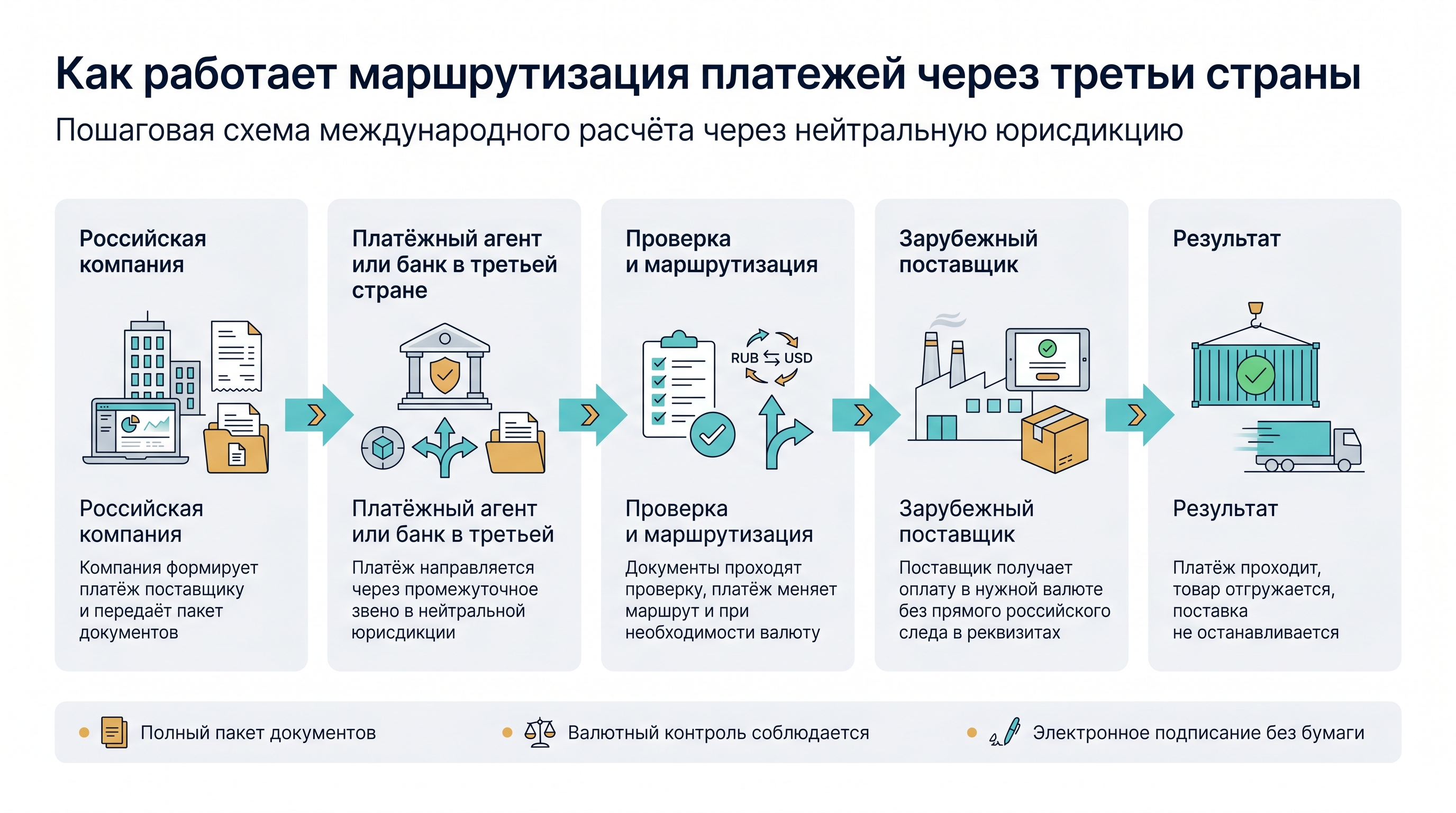
It is important to understand: This is not a gray scheme or a circumvention of sanctions. This is a legal international settlement infrastructure used by companies all over the world, including in countries that are not subject to restrictions. A full package of documents, an agency agreement, and currency control are all within the framework of Russian law.
UAE: the main hub for payments to Europe, Asia and America
The United Arab Emirates is today one of the key transit hubs for international settlements. Dubai and Abu Dhabi maintain correspondent relations with banks in almost all regions of the world. At the same time, the UAE has not joined the sanctions regime against Russia, which makes the Emirati banks a full-fledged intermediary.
It is convenient to pay via the UAE in:
- Europe — in euros through Emirati banks with European accounts
- The United States and Latin America — in dollars
- Southeast Asia — Thailand, Vietnam, Indonesia
- China — in yuan through partner banks in Hong Kong
The average time for a payment to pass through the UAE is 1-3 business days. The commission depends on the amount and currency, but is usually lower than when trying to make a direct transfer through European correspondent banks.
Armenia: quick settlements with the CIS and Europe
Armenia is a small but financially open jurisdiction. Yerevan banks traditionally maintain close ties with the Russian banking system and at the same time maintain correspondent relations with European partners. After 2022, the country has become one of the most actively used transit hubs.
Armenia is especially convenient for:
- Payments to Europe, especially to countries with which Armenian banks have long—standing relations
- Settlements within the CIS — Georgia, Azerbaijan, Belarus
- Small and medium—sized transactions - less compliance delays
- Urgent payments — the operating speed is higher than in the UAE
One of the advantages of the Armenian route is a relatively low entry threshold and minimal compliance stress for counterparties. A supplier from Germany or France receives a transfer from an Armenian bank — without a Russian trace in the details, which reduces the risk of blocking on the recipient's side.
Kazakhstan: a convenient route for payments to China and Central Asia
Kazakhstan is a strategically important jurisdiction for companies working with Chinese suppliers. The geographical proximity and long-standing trade ties with China make Kazakh banks a convenient link for settlements in yuan.
The Kazakhstan route is relevant for:
- Payments to China — especially when working with suppliers from border regions
- Settlements with Central Asia — Uzbekistan, Kyrgyzstan, Tajikistan
- Companies that already have a legal presence in Kazakhstan
- Parallel imports — goods that require a neutral route
An important caveat: in recent years, Kazakhstani banks have also strengthened their own compliance under pressure from international regulators. This means that you need to work through Kazakhstan with an experienced agent who knows which banks accept which transactions and how to properly process the documents.
How to choose the right route for your payment
The choice of route depends on several factors: the recipient's country, the currency of the payment, the nature of the goods, the urgency and the amount. There is no universal solution — something that works for paying for a Chinese supplier may be inconvenient for settlements with a European partner.
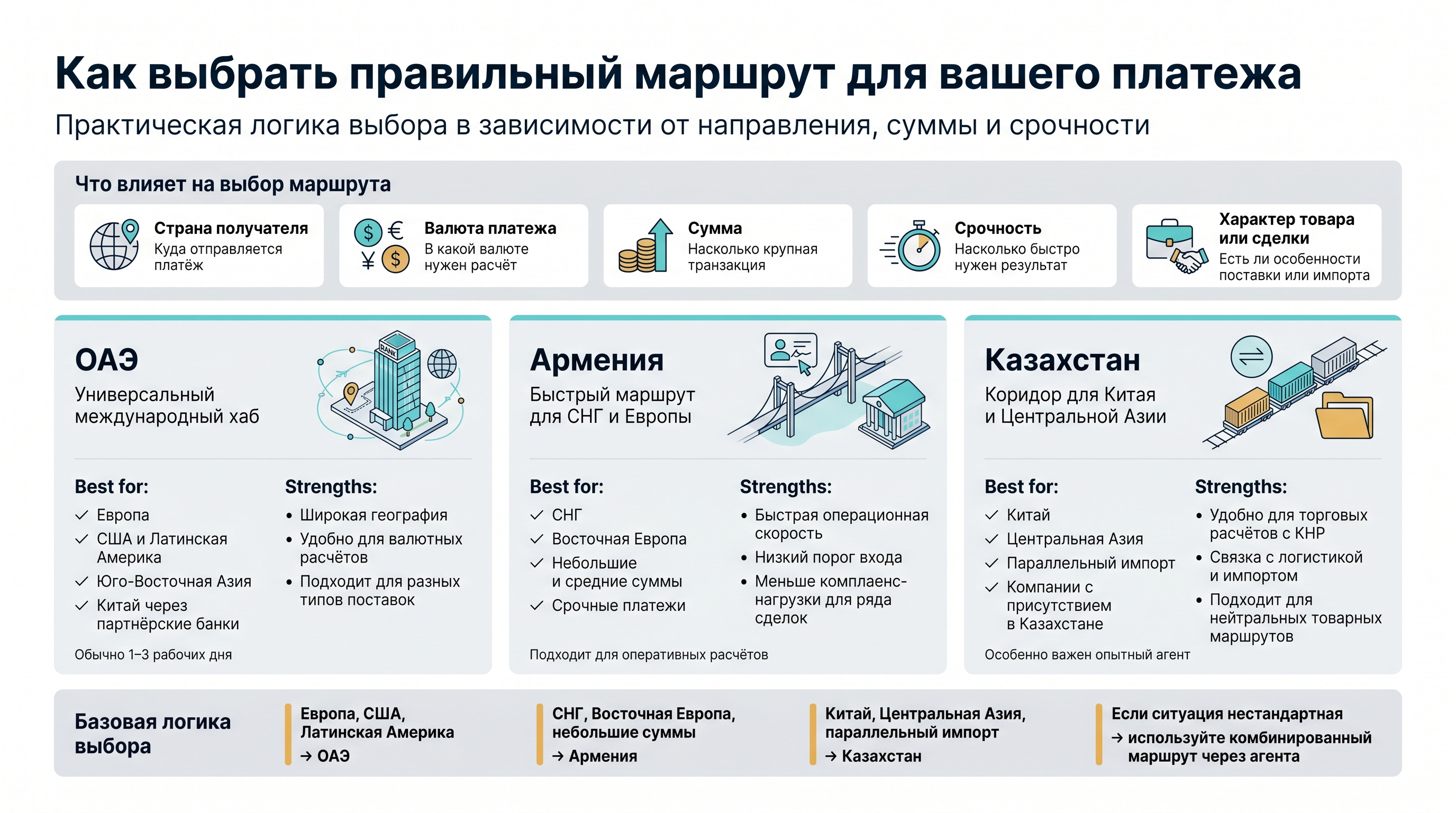
Basic selection logic:
- Europe, USA, Latin America → UAE
- CIS, Eastern Europe, small amounts → Armenia
- China, Central Asia, parallel import → Kazakhstan
- Southeast Asia, Thailand, India → UAE or direct channels through an agent
In practice, we often use combined schemes: the first tranche goes through one route, the next through another, depending on the current compliance situation of a particular bank. The payment landscape is changing rapidly, and a good agent always has multiple operational channels.
What documents are needed for payment via third countries?
One of the main questions that clients ask is: is it legal and what should I tell the accountant? The answer is unequivocal: the scheme is completely legal, and a complete package of documents is formed for each payment.
The standard set includes:
- Agency agreement between a Russian company and a payment agent
- Invoice from a foreign supplier
- A contract with a supplier (or an offer)
- Documents for currency control in a Russian bank
- Closing documents for accounting and customs clearance
All documents are signed electronically (EDS). Paper document management is not required. This significantly speeds up the process — the first payment can be made within 24 hours after signing the contract.
What to look for when choosing a payment agent
The market for payment agents has grown rapidly, and not all participants are equally reliable. A few criteria worth paying attention to:
- Commission transparency — the total cost should be fixed before sending the payment, and not calculated after the fact.
- Speed is the standard of the market today for 1-3 business days; if an agent calls a deadline of 5-7 days, this is a reason to be wary
- Documents — a reliable agent has a ready-made template for an agency agreement that is compatible with the requirements of Russian currency control
- Multiple routes — an agent with one channel is vulnerable; if this channel is closed, the payment is suspended
- Real cases are not "we work with 500 clients", but specific examples.: what is the situation, what is the solution, what is the result
Conclusion: third countries are not a workaround, but a new norm.
Routing through the UAE, Armenia and Kazakhstan is not a necessary measure today, but a standard practice of international settlements for Russian businesses. The companies that built these routes a year or two ago are now operating steadily. Those who continue to rely on direct channels regularly face delays, refunds, and supply stoppages.
Building a working calculation scheme is not a matter of luck. It's a matter of having the right partner with the right connections, experience, and multiple work routes in reserve.
If your business is facing difficulties with international settlements, please leave a request for advice. We will analyze your situation and suggest a specific route for your supplier and country.