
What is social capital and why is it ignored?
Social capital is a set of trust relationships, reputational assets, and network resources that a person or organization can use to achieve goals. It sounds academic. In fact, this is a call that is being accepted. A partner who enters into a deal without a long due diligence period. A client who comes based on a recommendation is already loyal.
Five years of working with business owners with a turnover of 500 million rubles or more show the same thing: companies underestimate this resource until it begins to decide the fate of the business. A crisis, a change in the regulatory field, the loss of a key counterparty — and it turns out that those who have built trust relationships survive. Not those who have more money in their account.
The paradox is that social capital is the only asset that cannot be bought outright. It cannot be balanced. It cannot be rented. But it is he who determines the speed of decision-making in conditions of uncertainty and the price of entry into new markets.
New Business environment: Why the old rules stopped working
We live in an era of structural turbulence. This is not a temporary crisis, after which everything will return to normal. This is the new normal: high regulatory volatility, restructuring of supply chains, accelerated digitalization of everything and everyone, simultaneous demand for deglobalization and global expansion.
In such an environment, the classic strategic tools — SWOT, five—year planning, linear growth through market share capture - work intermittently. The planning horizon has shrunk. The cost of the mistake has increased. And under these conditions, the speed of resource mobilization has become more important than their availability.
This is where social capital moves from the category of a "pleasant addition" to the category of a strategic resource. A company with strong horizontal ties — with partners, industry associations, the expert community, opinion leaders — adapts faster. She gets the information earlier. Solutions are cheaper. Resources come through trust, not through long negotiations.
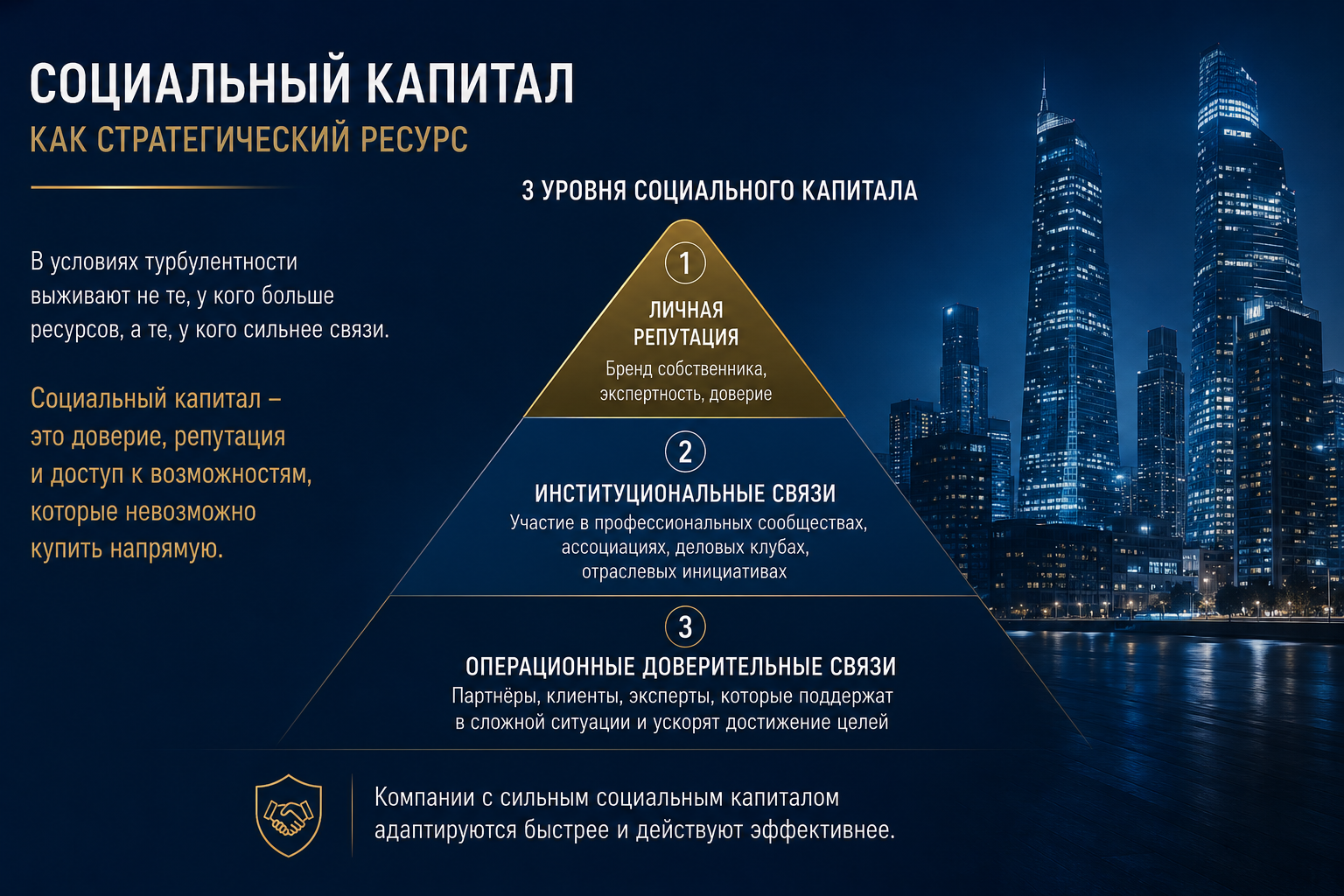
Three levels of social capital: where to look for growth points
In practice, I divide an entrepreneur's social capital into three levels — each of them requires a separate accumulation strategy.
Level 1. Personal reputation of the owner
This is the foundation. It all starts with how the first person is perceived by the market: as an expert, as a partner, as a man of his word. A reputation is formed over the years, but it is destroyed quickly — by one ill-considered public statement, one unfulfilled agreement, one demonstrative conflict with a partner. The first person is the brand of the company, even if the company has had more than one person for a long time.
Level 2. Institutional relations
This includes participation in professional associations, industry associations, business clubs, and strategic sessions. Not for show, but for a systemic presence in the environment where solutions are being formed. A company whose leader regularly speaks at congresses, moderates discussions, and initiates industry agendas has fundamentally different access to information and resources than one that operates only within its perimeter.
Level 3. Operational trust relationships
These are the specific people who will receive the call on Saturday. Partners who are ready to enter into a joint project without a month of negotiations. Customers who will say "I trust you" before they see the commercial offer. This level is the most valuable and most time—consuming. It is built through regular personal contacts, joint projects, and mutual support in difficult situations.
Metanoia: a change of mindset as a condition for capital accumulation
The Greek word "metanoia" means a change of mind, a profound shift in worldview. In the context of business strategy, it is a transition from the logic of "take" to the logic of "create". From transactional thinking to ecosystem thinking.
Most of the entrepreneurs I work with come with a transactional relationship model: every meeting is a potential deal, every contact is a resource for making a profit here and now. This logic is understandable and even effective in a stable environment. But it destroys social capital faster than it can be accumulated.
A meta-investment in a business strategy is when an owner starts investing in a bond without an immediate return. When he shares his expertise at the congress, not for the sake of leads, but for the sake of reputation. When he helps a partner in a difficult situation, without expecting a return service. It is this behavior that eventually converts into capital, which works when the money runs out, the market sank, or the regulator changed the rules of the game.
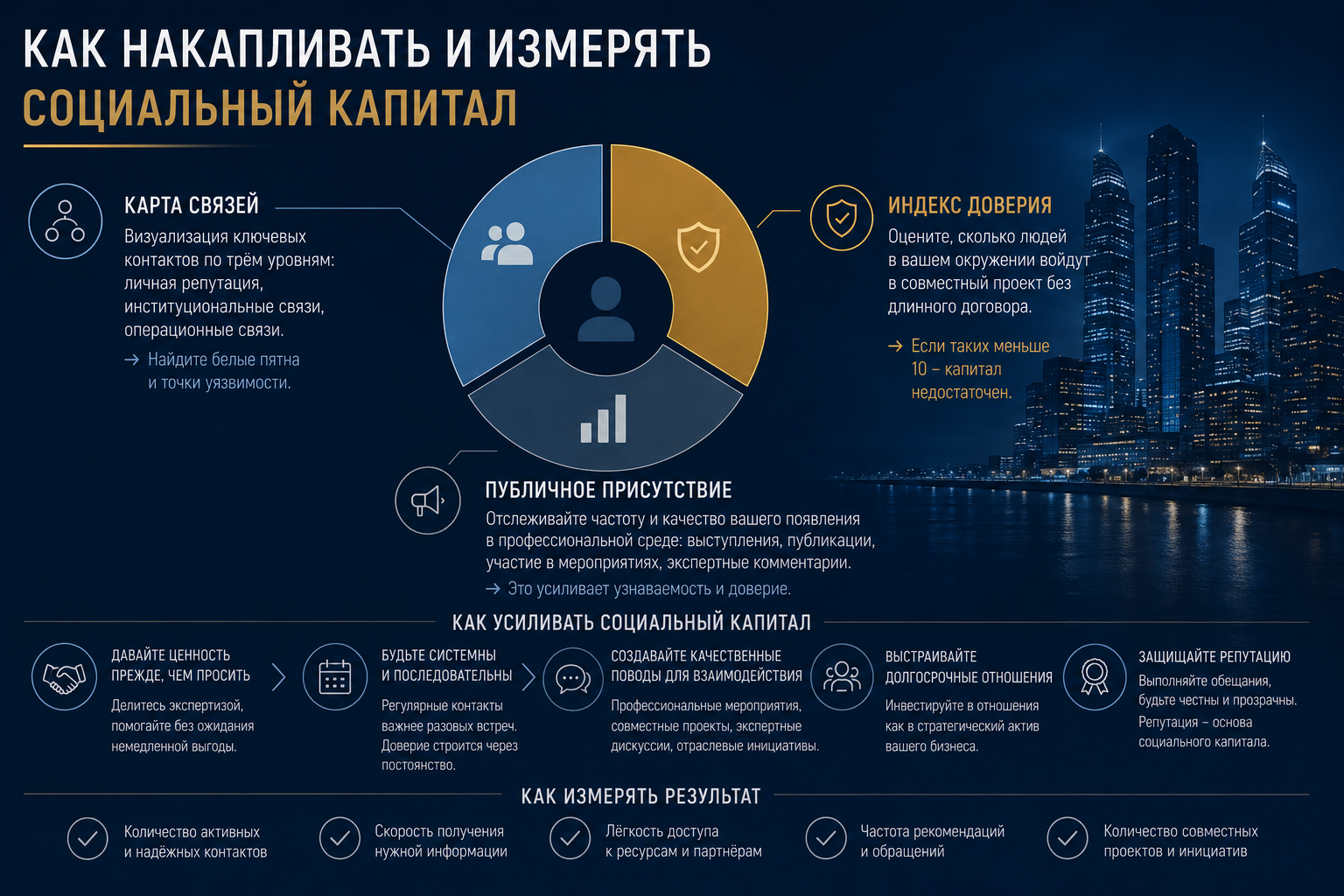
How to measure and start accumulating social capital: practice
The question that every owner asks is: okay, I get it, but how do I count it and where do I start? Here are the working tools that I use in strategic sessions.
- The relationship map is a visualization of key contacts on three levels: personal reputation, institutional presence, and operational partners. The task is to find white spots and points of vulnerability.
- The trust index is a subjective but working assessment: how many people in your environment will join a joint project without a long contract? If there are less than ten of them, the capital is insufficient.
- Public presence is the frequency and quality of appearance in a professional environment: speeches, publications, moderation. This is a deferred but high-return investment.
- Reputation audit — what do people say about you outside your circle? It is useful to do this once a year through trusted intermediaries.
A reciprocity strategy is a conscious investment in other people's projects, recommendations, and expert support without waiting for an immediate return.
Social capital and strategy: points of intersection
In twenty years of working with companies in the real sector, I have not met a single sustainable business that survived in crises only due to a financial cushion. Each time, there was a person, a partner, a connection that opened the right door at the right moment. This is not an accident. This is the result of systematic work with social capital, which a competent owner conducts long before the door was needed.
Today, when the planning horizon has been reduced to 12-18 months, and the rate of change is faster than the rate of adaptation of most companies, social capital has ceased to be a "soft" complement to strategy. He became her infrastructure.
A strategy without social capital is a map without roads. It's a beautiful scheme with the right goals and resources, but no people willing to help you get there. In the new realities of the business environment, the winner is not the one who has developed a smarter plan. And the one who found the right person faster.
The main question I ask owners at strategic sessions is: if a key parameter of your market changes tomorrow, who in your environment will help you rebuild in two weeks? If the answer comes with difficulty, it means that working on social capital has long been a top priority. Not tomorrow. Now.