






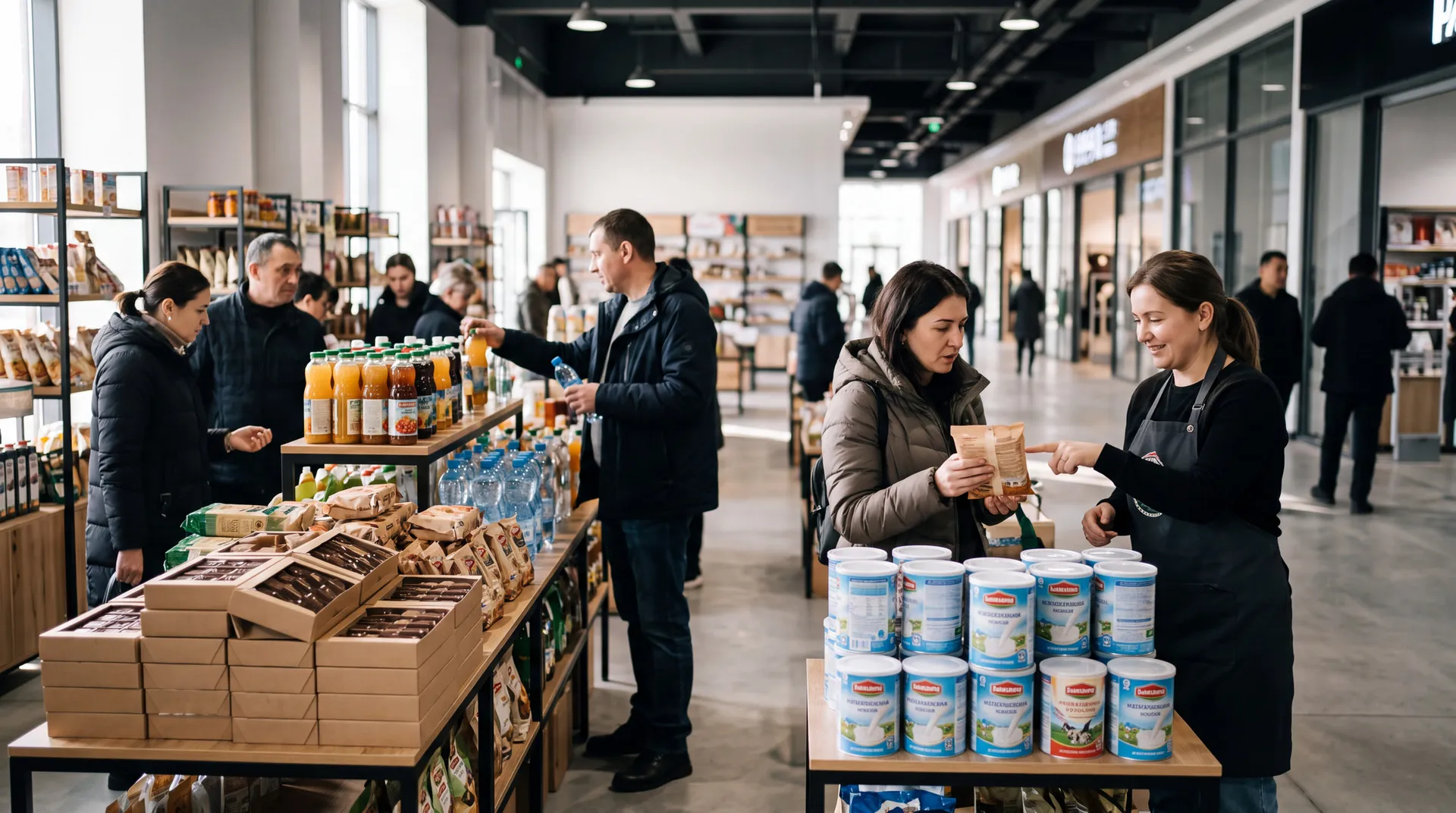
The pavilion is located in the Epindo shopping centre on Big Heihe Island. At launch, it offers 207 items in six categories: beverages, biscuits and wafers, chocolate, canned food, fruit puree and powdered milk.
The venue combines three functions: a showroom for the product range, a trade and business platform, and a tool for promoting Belarusian brands on the Chinese market. The parties intend to create a replicable model, with standards for selecting the range, designing exhibition spaces, operational management and marketing, and then roll it out across China.
Before the opening, the Chinese and Belarusian sides held talks on product licensing, supply guarantees and the procedure for passing through checkpoints. Following the talks, a number of cooperation agreements were signed.
Heihe was chosen as the entry point deliberately. The city is located in the Heilongjiang Pilot Free Trade Zone, which opens up preferential customs clearance. There are plans to arrange direct purchases from Belarusian manufacturers, organise on-site processing of goods and launch cross-border e-commerce. Through the Heihe checkpoint, the plan is to attract distributors from different regions of the country to cover Northeast China, the Beijing–Tianjin–Hebei agglomeration, the Yangtze River Delta and the Guangdong–Hong Kong–Macao Greater Bay Area.
The project builds on an established diplomatic foundation. In May 2026, the 35th Harbin International Economic and Trade Fair held a themed day, “Heihe Area of the Heilongjiang Pilot FTZ — Belarus”, where the parties stated their intention to turn Heihe into the main distribution hub for Belarusian exports to China.
For Belarusian suppliers, the opening of the pavilion means a legal, structured sales channel with a ready-made logistics chain: manufacturer, consolidation in Heihe, distribution across China. The next step is scaling up the model: if the scheme delivers commercial results, similar pavilions may appear in other Chinese cities.
Related news:
- REC expands the Made in Russia network in China — how Russian goods are promoted in China
- An exhibition of Chinese goods opened in Minsk — how Chinese goods are entering the Belarusian market
- China and ASEAN increased trade to $1.05 trillion: what CAFTA 3.0 brings — how China’s trade with Southeast Asia is growing
- China cuts the VAT refund on electric vehicle exports from 13% to 9% from April 2027 — how China’s export policy is changing