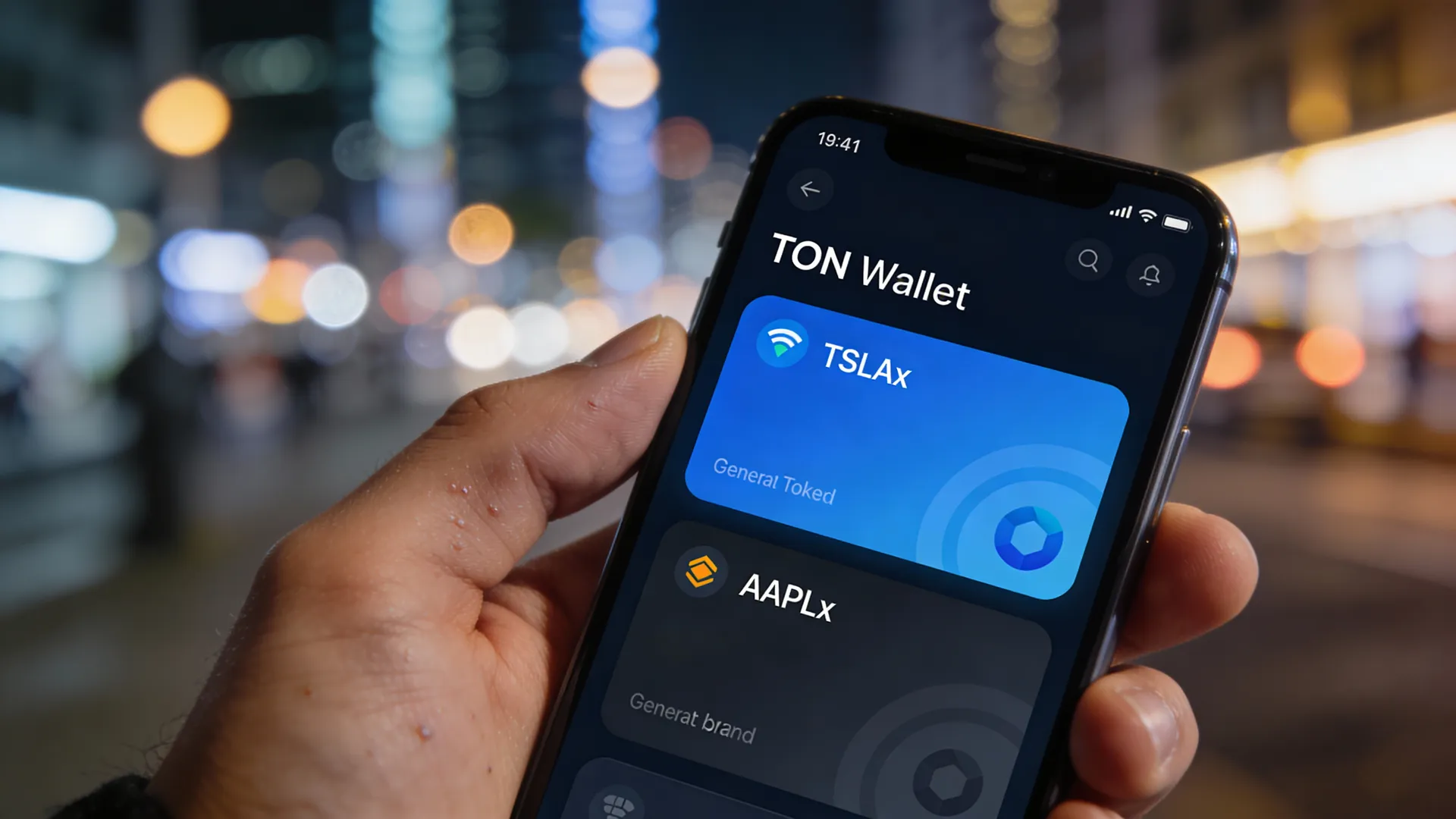
The key news is that xStocks, tokenized instruments linked to the share price of major American issuers and index products, have become supported in the TON ecosystem not only through the built—in wallet service, but directly in regular TON wallets. This changes the ownership architecture: the user can store the asset in himself (self-custody), rather than "on the service side", and perform operations through a decentralized infrastructure — faster, with potentially less dependence on intermediaries and with more flexible usage scenarios.
It is also important that we are not talking about "stocks on the stock exchange", but about tokens that repeat the price of the underlying asset and, according to the developers, are backed by real securities. For the market, this is a compromise between the usual financial instruments and the crypto approach: the price follows the exchange rate, and the turnover lives on the blockchain. The next obvious step is to use such tokens in DeFi: collateral for loans, collateral for derivatives, and liquidity in pools. In practice, this can expand the "financial usefulness" of the instrument, but at the same time increases the risks: volatility, smart contracts, DEX liquidity and pricing gaps in stress scenarios.
The legal side is the main constraint. Such products are often unavailable in the United States and a number of "tough" jurisdictions: regulators there are particularly attentive to what economically looks like a security. Therefore, the geography of admission becomes a competitive factor: in some cases, a product can be offered en masse, while in others it can only be offered to narrow categories or not at all. That is why the market, as a rule, grows "patchwork": through partnerships with exchanges, wallets and networks that are able to build compliance and cut off prohibited regions.
For the foreign economic activity and BRICS agenda, it is not so much the "investor hype" that is important here, as the infrastructural trend: tokenization makes financial instruments portable between ecosystems and potentially suitable for settlements/collateral in cross—border digital chains. But for this to become a real "bridge" for trade and logistics, clear rules for access, identification, reporting and investor protection are needed — otherwise, scaling will run into regulatory barriers faster than into technology.