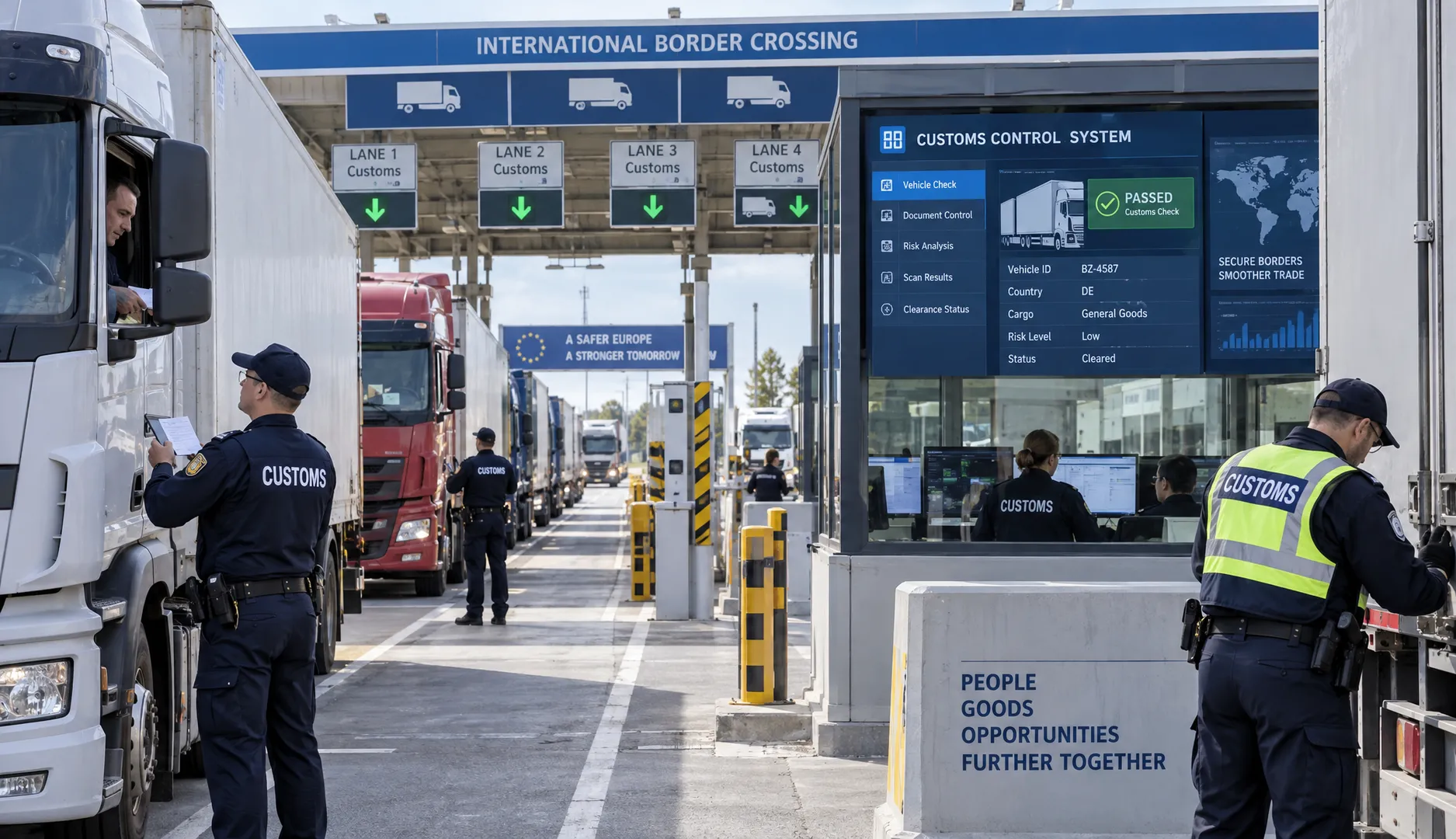
The concept was presented by Anna Korosteleva, Deputy Head of the Federal Customs Service, at the foresight session "Checkpoint in 10 minutes. And this is just the beginning!" during the international forum "Transport of Russia" in Moscow. More than 300 experts participated in the discussion within the framework of the jubilee "Transport Week", which this year turned 20 years old.
The model is based on advance notifications: the carrier transmits information about the vehicle and cargo before arrival at the border, and the control authorities carry out a risk assessment in advance. Cargoes without identified risks pass through the checkpoint faster — some of the operations that are currently being performed after the actual arrival of the transport are transferred to the preliminary stage. The FCS reported that the use of preliminary data has already reduced the time of individual control operations.
The central element of the new architecture is the Integrated Access Control System. It should integrate into a single information environment all departments involved in border control: the customs service, transport, veterinary, phytosanitary and other types of state supervision. Without such a platform, each agency requests information about the cargo separately, the carrier goes through the procedures sequentially, and downtime is summed up. The ISP should eliminate duplicate requests and synchronize checks.
"The main key to success for us is efficiency. We are currently considering the checkpoint as a territory of interaction and are maximally focused on solving these tasks," said Anna Korosteleva.
There is one practical consequence for importers and exporters: the completeness and reliability of pre-submitted information about the cargo become critically important. It is on their basis that the system will form a risk profile. An error or omission in the notification is highly likely to result in the shipment being sent for in—depth inspection upon arrival, and will increase rather than reduce downtime.
At the same time, the preliminary analysis does not cancel the physical inspection: if the system detects a risk, the vehicle or cargo will still be sent for additional control measures. The effectiveness of the model depends not only on the IT infrastructure, but also on the capacity of the checkpoints themselves and the coordination of the actions of the departments.
The FCS has not yet disclosed the specific timing of the replication of the system for all automobile border crossings and the list of transport categories for which accelerated passage will be available. The name of the session "in 10 minutes" reflects the target, but not the fixed standard that has already been put into effect.
Related news:
- They want to cross the border in 10 minutes by 2030: what is being changed at the checkpoint — the "10 minutes" target for checkpoints
- MAPP Bumpy received non—stop Truck Inspection Scanners - Non-stop Truck inspection Scanners
- Russia will reduce the time of truck inspection at the border to 10 minutes — the plan is to reduce the time of inspection at the border
- The SPOT system brought 34 billion rubles to the budget in three months — how the SPOT system works
- Why cargo may be delayed between the BRICS countries and how to avoid it — why cargo is delayed at the border and how to avoid it