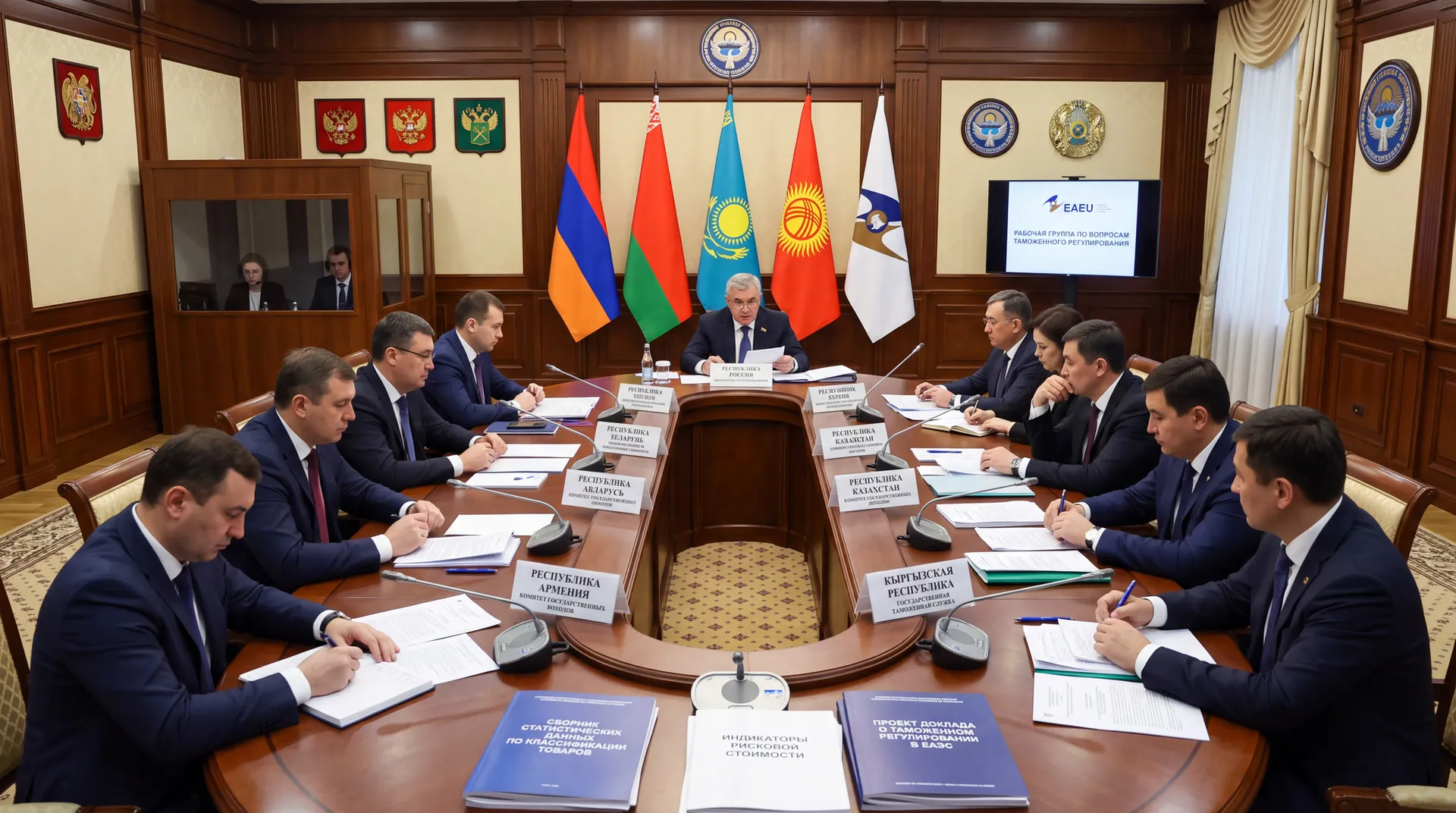
The 56th meeting of the Joint Board of Customs Services of the EAEU Member States was held in Gyumri under the chairmanship of Valery Pikalev, Head of the Federal Customs Service of Russia. Representatives of the five countries of the Union considered 21 issues: from risk management and product classification to digitalization and joint law enforcement activities.
The work program of the working groups for 2027 and the action plan in the law enforcement sphere for 2027-2030 have been approved. The document provides for the development of information and analytical interaction, professional development of employees and joint practical events.
Cost-based risk indicators remain one of the priorities of our joint work. In 2026, their use provided revenue to the Russian budget of over 27.5 billion rubles, which is 12.7% higher than planned. The indicators identify shipments with potentially undervalued customs values and send them for additional verification. According to the position of the FCS, they do not establish a minimum customs value and do not replace the methods of determining it according to the Customs Code of the EAEU — however, in practice, it is the discrepancy with the indicator that serves as the basis for requesting additional documents and adjusting the cost. Synchronization of approaches between the countries of the Union will reduce the possibilities for choosing a "soft" point of entry.
At the initiative of the Kyrgyz side, the participants exchanged experiences in applying the temporary import procedure for goods intended for display at exhibitions and fairs without subsequent sale. Such goods are placed under the procedure subject to the conditions for the duration of stay in the customs territory and the procedure for completing the procedure. Uniform application of the rules is important for companies that participate in international exhibitions and business events on the territory of the EAEU.
Valery Pikalev presented to his colleagues the results of the modernization of the FCS information infrastructure. Two projects have been given priority status: the Unified Automated Information System of the Customs Authorities of the New Generation (EAEU TO) and the Center for Preliminary Decisions on the classification of Goods. In 2026, the Information Technology Center of the Federal Customs Service of Russia began operating, a structure for the centralized development and application of digital solutions.
Preliminary decisions on classification allow the participants of the foreign economic activity to fix the product code in advance according to the Customs Code of the EAEU. This reduces uncertainty in the calculation of customs duties, the application of prohibitions and restrictions, and the preparation of documents for declaration. Expanding the practice of such solutions will reduce the number of classification disputes at the customs clearance stage.
The next, 57th meeting of the OCTS is scheduled for the first quarter of 2027 and will be held in Kyrgyzstan. By that time, the working groups should report on the first results in the approved areas, including the unification of cost indicators, which will affect all companies importing goods across the external border of the Union.
Related news:
- The EEC has approved the procedure for clarifications on the technical regulations of the EAEU — how the EEC explains the technical regulations
- The unified transit system of the EAEU has been launched: one document for the entire route is the unified transit system in the EAEU
- The EAEU has increased duties on clothing, electronics and equipment since November 1. What duties has the EAEU increased since November 1
- CCC: How to properly respond to customs requests and protect customs value — How to respond to Customs value requests