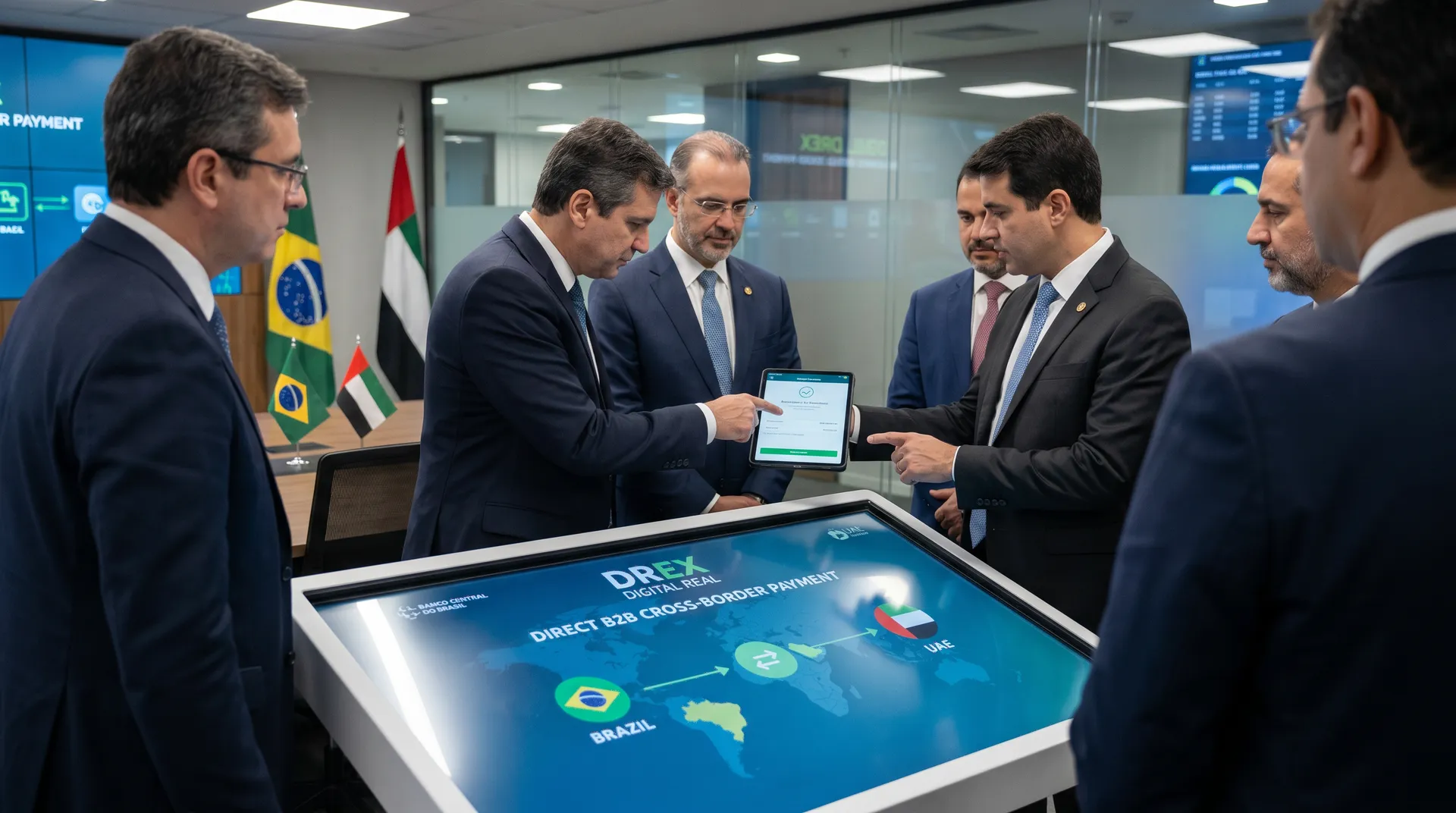
Brazil has so far tested Drex primarily for internal operations and transactions within BRICS. Connecting the UAE is a qualitative shift: a country outside the BRICS, with Western financial ties, is connecting to the settlement infrastructure, which is being built bypassing the dollar circuit.
Why the UAE
The UAE is a global financial hub with one of the most advanced regulatory approaches to digital currencies. ADGM (Abu Dhabi Global Market) and DIFC (Dubai International Financial Centre) have created an environment in which experiments with CBDC and cryptocurrencies take place in a legal framework.
The digital dirham is being developed by the UAE Central Bank as part of the mBridge project, a multilateral CBDC experiment jointly with China, Hong Kong and Thailand. Connecting to Drex means expanding this network to Brazil.
How the CBDC bridge works
The Brazilian company makes the payment in Drex. Through the CBDC bridge, the payment is converted into digital dirhams on the UAE side and sent to the Emirati partner. Without SWIFT, without correspondent banking, without delays from 2 to 5 days. The transaction takes seconds.
At the pilot stage, the volume of transactions is limited, and participants are selected. But the fact that the channel is working sets a precedent.
What does this mean for Russian companies?
The UAE is a key transit hub for Russian payment schemes with Brazil. If a company trades with a Brazilian partner through a Dubai intermediary, this intermediary can theoretically use the Drex-dirham bridge for faster and cheaper settlements.
There is currently no direct access for Russian companies to Drex. But the expansion of the UAE's CBDC infrastructure towards BRICS currencies is gradually creating a payment network in which the ruble through yuan or dirhams can become part of the working route.
Companies working with Brazil should monitor the development of the pilot: if successful, a cheaper and faster channel will appear through Dubai partners.