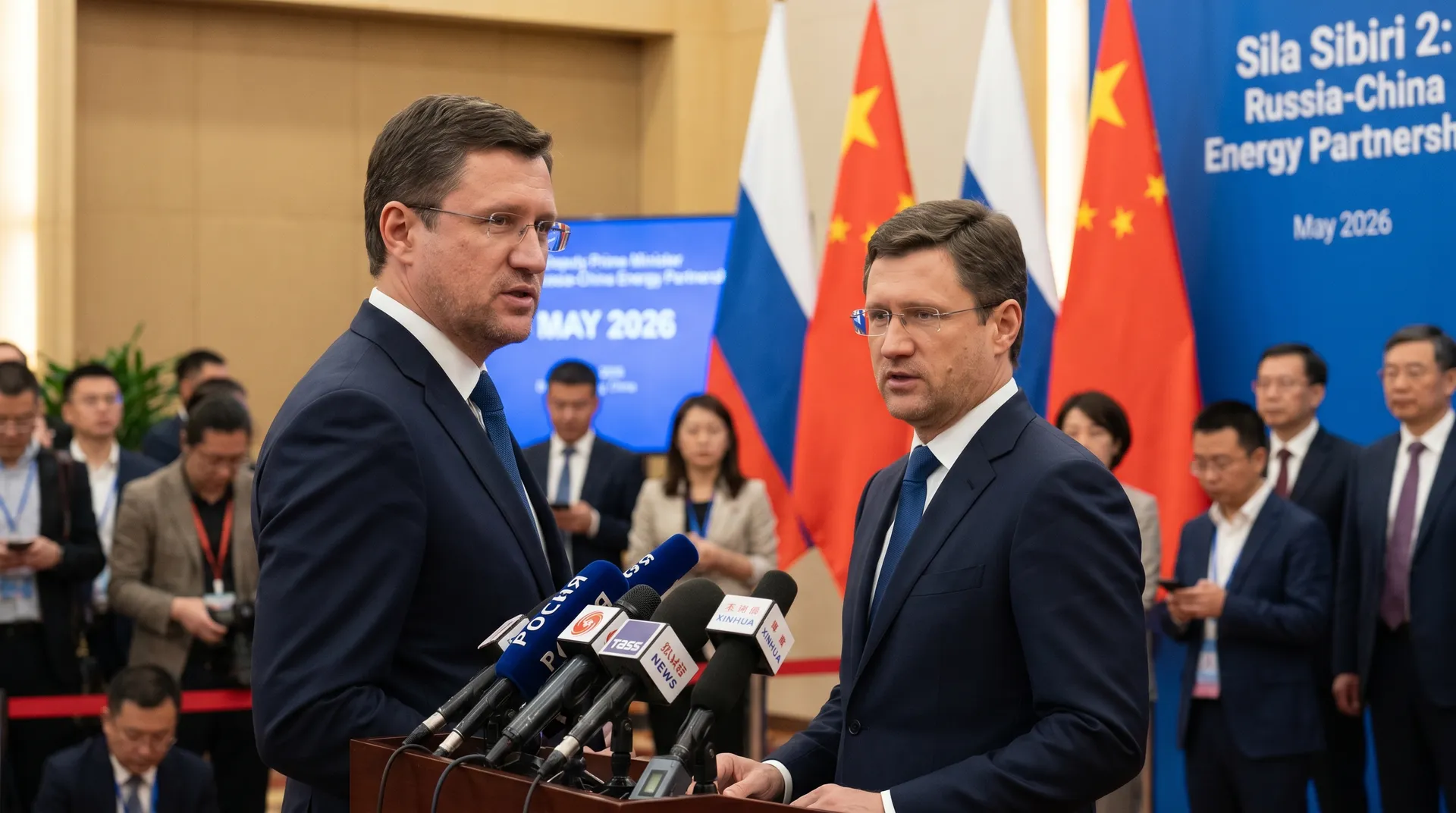
The Power of Siberia—2 has been discussed for more than ten years. The route through Mongolia — Altai —Xinjiang was agreed upon several times, changed, and returned. This time Novak speaks specifically: the companies are at the finish line.
"Work is underway, and the final agreements on specific contracts are already at the finish line between the companies. As for political decisions, agreements at the level of the leaders of the countries were reached earlier, and now technical work is underway, the contracts themselves are being finalized," Novak said following Putin's visit to Beijing.
Peskov added: there is an understanding on the route and the organization of construction. There are still nuances — the work will continue. The Chinese Foreign Ministry confirmed its willingness to cooperate.
What is the Power of Siberia — 2 and why is it needed?
A gas pipeline with a capacity of up to 50 billion cubic meters per year should pass through Mongolia and connect the West Siberian fields with the Chinese market. This is several times more than the current "Power of Siberia — 1" (38 billion cubic meters per year through the Far East).
China wants to diversify its energy sources, especially now that the availability of Iranian and Middle Eastern gas is under threat due to the situation in the Strait of Hormuz. Russia wants a reliable long-term sales market for West Siberian gas, historically oriented towards Europe.
Novak separately noted that China is also interested in increasing Russian oil supplies. In the first four months of 2026, Russia increased oil supplies to China by 10%.
Why is the finalisation taking so long?
The key differences are commercial. Gas price: China insists on conditions close to the domestic Russian market; Russia is counting on European market benchmarks. Investment model: who is financing the construction of the Mongolian section and how the risk is distributed. Payment mechanism: rubles, yuan or a mixed scheme.
According to Peskov, all these issues are "practically resolved" — technical nuances remain. Experts interviewed by Vedomosti suggest signing at SPIEF 2026 (June) or on the sidelines of the SCO autumn summit.
What does this change for trade and logistics
The Power of Siberia—2 is not just a pipe. It is followed by infrastructure: compressor stations, roads, villages, logistics hubs along the route through Mongolia and Altai. This is a long-term flow of construction goods, equipment, and machinery.
For Russian and Chinese companies working in the construction, energy and transport sectors, the launch of the project opens up a large contract market. The Mongolian section of the corridor can also become the basis for the development of overland transit between Russia and China.
Russia is simultaneously increasing oil supplies to China, up 10% in four months. Together with the potential gas contract, the Eastern energy sector is becoming the main axis of Russian exports for the coming decades.