







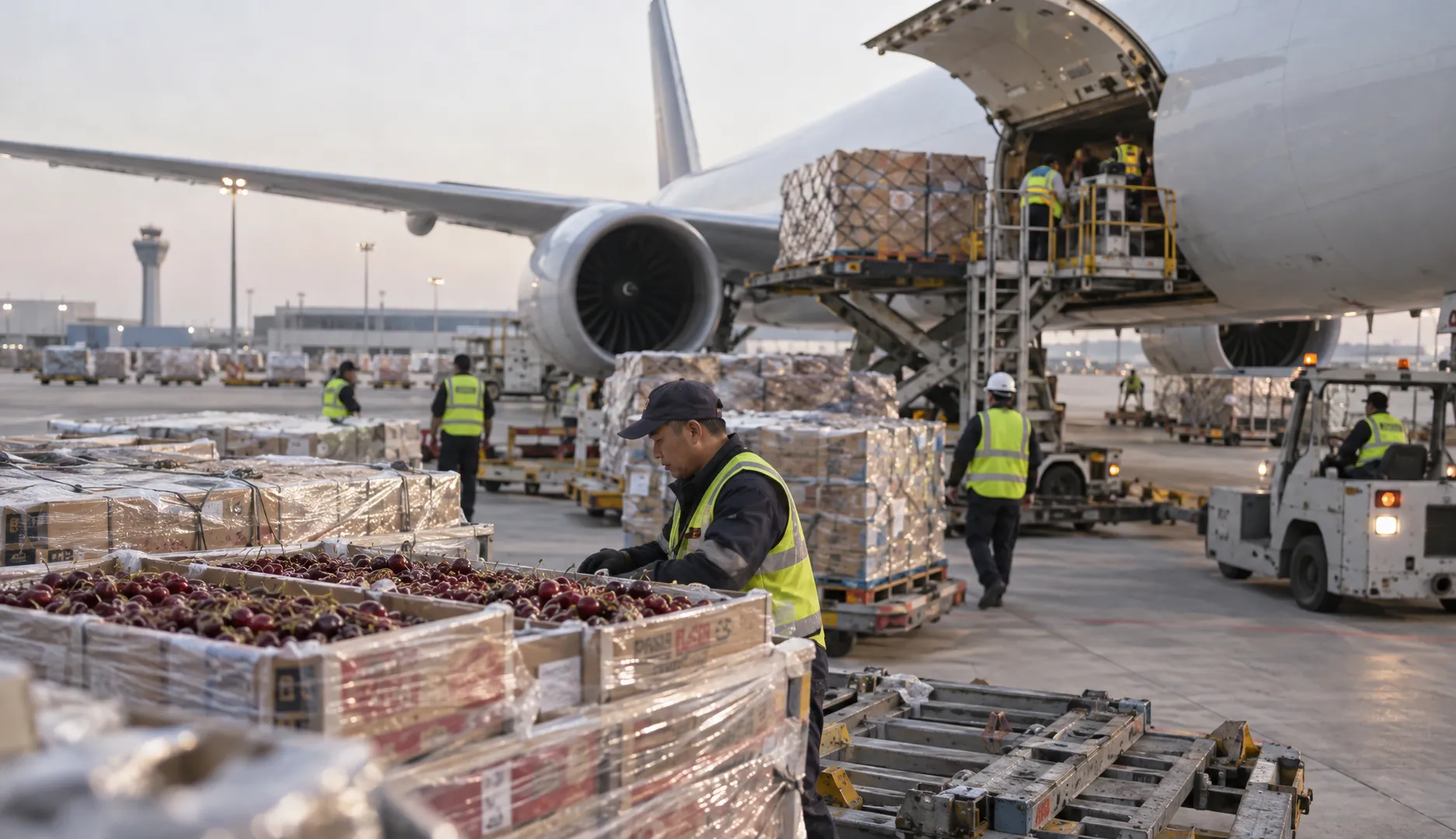
The first flight of the new season landed in Ezhou on Monday with a cargo of Chilean cherries — this flight launched the route that links the airport twice a week with Addis Ababa, Sao Paulo and Santiago. The aircraft are Boeing 777Fs. Return flights are loaded with Chinese cross-border e-commerce goods.
At the same time, a second route started operating: Ezhou — Addis Ababa — Sao Paulo — Buenos Aires. It is operated once a week by the same Boeing 777Fs and specialises in importing salmon and beef. Addis Ababa Bole, one of Africa's largest air cargo hubs, serves as an intermediate hub on both routes.
According to an airport representative, imported fresh produce reaches Chinese consumers within 48 hours. Fewer transit connections are the main technical advantage of the new scheme for shippers of perishable goods.
For South American exporters of cherries, salmon and beef, the route creates a direct channel to China without rerouting via European or Middle Eastern hubs. Suppliers from Chile and Argentina get a predictable schedule — two and one flights a week respectively — and the ability to plan shipments for specific dates.
Chinese cross-border e-commerce sellers, in turn, get regular cargo capacity on outbound flights. Ezhou Huahu airport is positioned as a specialised cargo hub: unlike airports with combined passenger traffic, priority here is given to freight, which reduces competition for slots and simplifies supply planning.
The launch of the routes expands direct air links between BRICS countries — China, Brazil and Ethiopia, which joined the association in 2024. For foreign trade participants working with South American counterparties, regular flights via Ezhou mean an alternative to sea freight where timing is critical: above all for seasonal fresh produce and urgent e-commerce consignments.
Related news:
- A high-speed highway opened in China to the largest cargo airport in Asia — how a high-speed road was built to Ezhou Huahu airport
- Wuhan opened a direct container train route to Ulyanovsk — container trains from Wuhan to Ulyanovsk
- Air freight from Hong Kong to Europe rose by 8.8% in a year — how air freight rates are changing
- Ethiopia launches duty-free trade across Africa via AfCFTA — how Ethiopia is developing trade in Africa
- Air cargo in BRICS: pros, cons and costs — pros, cons and cost of air freight in BRICS