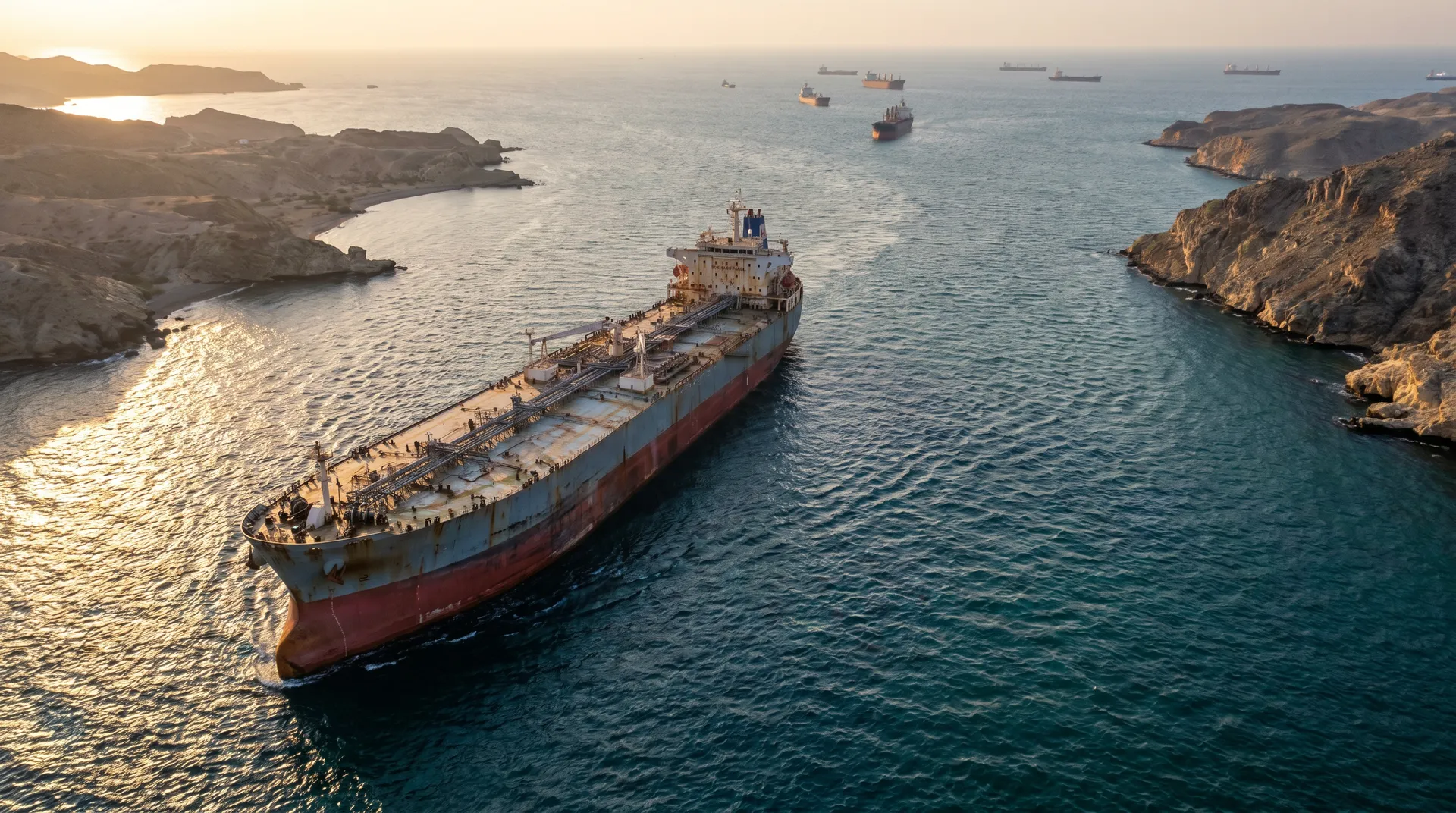
The strait was closed for two days. Then Trump backed down, following talks with Xi Jinping in Beijing on May 14. Iran has started to let some Chinese ships through. The situation has stabilized, but not returned to normal: the strait is open, but the tension has not gone anywhere.
What is the Strait of Hormuz and why is it important?
The Strait of Hormuz connects the Persian Gulf with the Gulf of Oman and further to the Indian Ocean. The width at the narrowest point is about 34 km. About 20% of the world's oil and gas supplies pass through it. It is the world's largest marine route for energy resources, with 17 to 21 million barrels of oil equivalent passing through the strait every day.
The countries that depend on supplies through Hormuz are China, Japan, South Korea, India, and most European consumers of Middle Eastern oil. For China, the strait is a key supply route for Iranian oil, which China buys at discounted prices, bypassing Western sanctions.
What happened
Against the background of the US-Iranian military conflict, which escalated in February–March 2026, Iran imposed restrictions on the passage of ships through Hormuz. Trump announced a blockade of the strait, which lasted two days. The scale of the shutdown: dozens of ships are stuck waiting.
At the talks in Beijing on May 14, Xi Jinping outlined China's position: against the militarization of the Strait and any attempts to charge passage fees. The parties agreed that the route should remain open for energy supplies. After the first day of negotiations, Trump lifted the blockade. Iran has started to let Chinese ships through.
Why Chinese ones?
China is the largest buyer of Iranian oil. That is why Tehran started by allowing passage for vessels associated with the PRC. This is not a random sequence: China, as Iran's largest trading partner, has leverage on both sides of the conflict, and partially opening the strait specifically to Chinese vessels is a pragmatic step by Tehran, demonstrating its readiness to de-escalate without capitulation.
For vessels of other flags, the situation remains less certain. Insurance risks on the route through Hormuz are still increased.
Implications for prices and routes
Brent crude oil reached $105.33 per barrel on May 13, amid Trump's rejection of the Iranian peace plan. After the de-escalation signals, the pressure on prices decreased slightly, but $100+ per barrel is a different freight rate regime than it was a year ago.
During the period of instability, sea freight from the Persian Gulf is becoming more expensive for several items at the same time: military insurance (War Risk Premium) is growing significantly, some ships are leaving for alternative routes through the Cape of Good Hope, which adds 10-15 days to the journey. The increase in freight rates is translated into the cost of the goods for the final buyer.
Alternative routes: what is already involved
While Hormuz was closed or partially restricted, part of the cargo flow was redistributed.
The route through the Cape of Good Hope (the southern tip of Africa) is longer and more expensive, but it does not pass through the conflict zone. Its use has increased since 2024 against the background of the Houthi attacks in the Red Sea.
The pipeline route through the UAE (the ADCO oil pipeline from Abu Dhabi to Fujairah) allows part of the Emirati oil to enter the market, bypassing the strait. The capacity is about 1.5 million barrels per day.
In this context, the transport corridor through Iran (Bandar Abbas - the north of the country) and further through the Caspian Sea and Russia via the North—South Transport Corridor turns out to be a strategically interesting alternative route for part of the cargo going to Asia.
MTK North—South as a beneficiary of the crisis
The North—South International Transport Corridor, a route from Russia through Iran to India and back, does not pass through Hormuz. For cargo moving between India and Russia, as well as between Russia and the Persian Gulf, this corridor becomes more attractive when sea routes are unstable.
The port of Bandar Abbas— the main point of access of the North—South MTK to the sea, is located at the exit of the Strait of Hormuz. When the strait is closed, it is actually isolated. But the corridor also uses the Caspian Sea: Astrakhan — Enzeli (Iran) without passing through Hormuz.
For Russian logistics companies and exporters looking at southern routes, the crisis around Hormuz is an argument in favor of diversifying routes and investing in the North—South MTC.
Risks that haven't gone away
The situation has not returned to normal — it has entered a phase of fragile equilibrium. Several factors continue to put pressure on:
The Iranian nuclear program and the US position on it are the main source of instability. Negotiations are continuing, but there have been no mutual concessions.
The American military presence in the region. The warships remain in the Persian Gulf and the Arabian Sea.
The Houthis in Yemen continue to threaten shipping in the Red Sea. This closes the main route through the Suez Canal for some shipowners, reducing alternatives.
Insurance conditions. The War Risk Premium on ships in the Persian Gulf is still significantly higher than normal levels. Until this changes, the freight cost will remain elevated.
Practical actions for business
For companies importing goods from the Persian Gulf countries (UAE, Bahrain, Kuwait), as well as transit cargo through Iranian ports, check the current insurance conditions and clarify with the carrier which route the cargo goes through. Many shipowners switch to the Cape of Good Hope route without notifying the client, which adds time and money.
For companies planning new contracts with suppliers from the Persian Gulf, it is recommended to include force majeure conditions in the contracts, taking into account the instability of routes.