







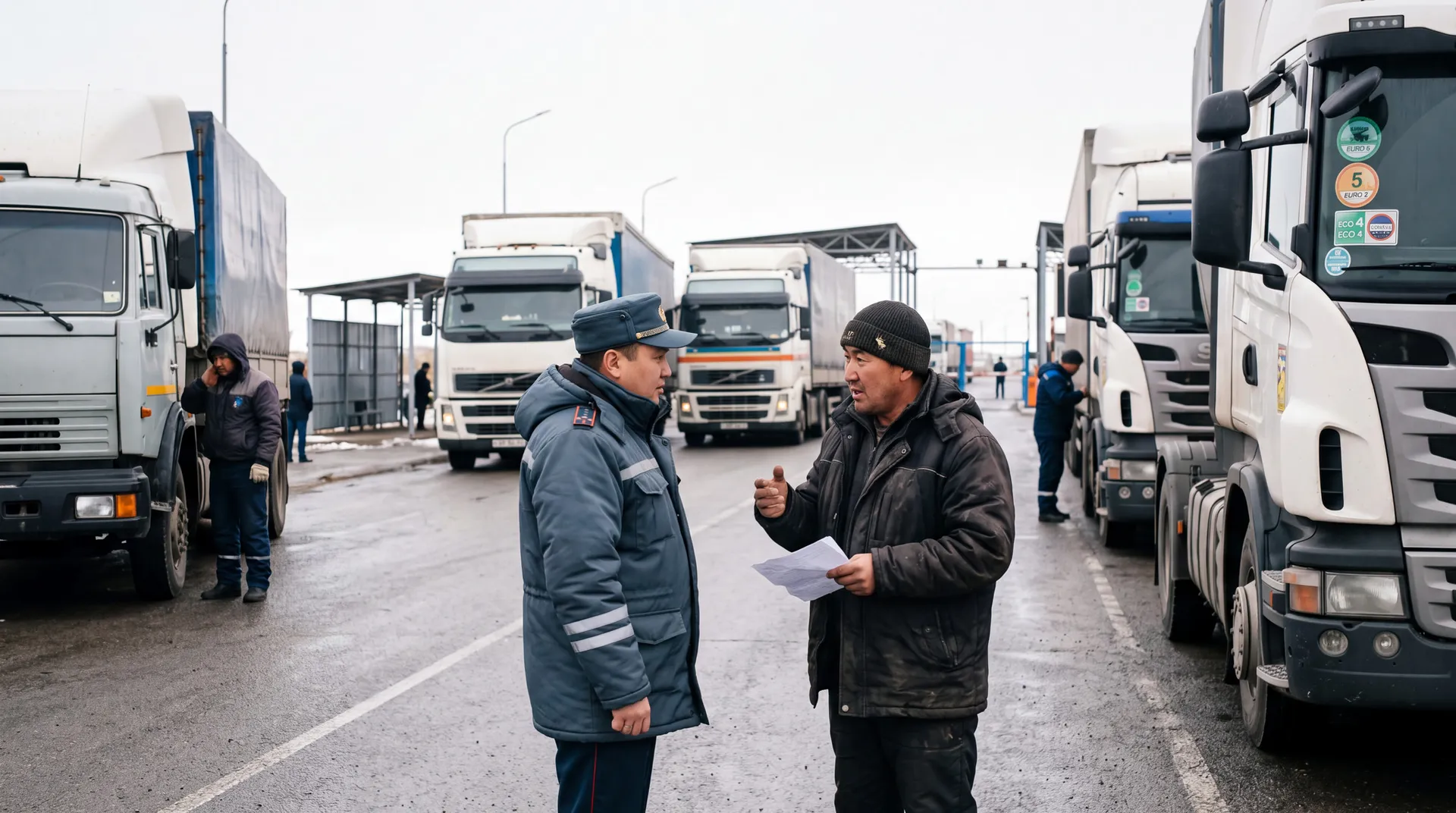
The first meeting of the working group on reforming road fees took place in November 2026. Participants considered three main areas: introducing insurance for foreign trucks when crossing the border, differentiating tariffs by environmental class and emissions, and annual passes for Kazakh transport companies.
Deputy Prime Minister and Minister of National Economy Serik Zhumangarin outlined the main goal of the reform: road infrastructure should pay for its own maintenance through the fees collected, rather than being covered from the budget, as is the case now.
Foreign carriers were the focus of several proposals at once. Independent insurance expert Aigerim Karabyyykoglu proposed creating a mechanism for insuring foreign trucks on entry into the country and at the same time bringing Kazakh road tariffs in line with neighbouring states — while keeping preferential terms for domestic carriers.
For Kazakh transport companies, Farkhad Nurkamalov, business analyst at QazAvtoZhol, proposed annual passes. In his view, this tool would allow carriers to prepay planned mileage and reduce costs for large volumes of trips, while the budget would improve collection and reduce arrears.
Mazhilis deputy and logistics and transport expert Bolatbek Nazhmetdinuly advocated a new tariff principle: rates should depend on the vehicle category, its carrying capacity, environmental class and emissions. All participants agreed on the need to expand digital tools for monitoring payments on the roads.
The reform will not affect private passenger cars — all changes apply exclusively to commercial trucks.
The Kazakh government press service put its position as follows:
"In further developing the approaches, it is necessary to take into account the interests of carriers and business, as well as to ensure a fair distribution of road infrastructure maintenance costs. The main focus is proposed to be on commercial freight transport, without affecting private passenger cars."
The working group is to prepare a specific list of proposals by the end of November 2026. The next stage is discussion with government agencies, industry associations and business representatives.
For Russian and other foreign carriers using Kazakh routes for transit to China, Central Asia and beyond, the reform creates a risk of higher transport costs. Mandatory insurance at the border will add an operational step at every entry, and higher tariffs without benefits for foreigners will directly affect the cost of delivery on the Kazakh leg.
Related news:
- Kazakhstan introduces freight transport priorities from December 20 — what freight transport priorities Kazakhstan is introducing
- Russia and Kazakhstan launched freight transport with the e-CMR electronic waybill — how the e-CMR electronic waybill works on routes with Kazakhstan
- Mashtakovo checkpoint to expand from 10 to 36 lanes by 2028 — expansion of the Mashtakovo checkpoint on the border with Kazakhstan
- Kazakhstan to ban imports of cars older than five years without Euro-5 from December 2026 — which cars Kazakhstan will ban from import from December
- Imports from China in 2026: 22% VAT, duties and navigation seals on the route through Kazakhstan — costs and seals on the route from China through Kazakhstan