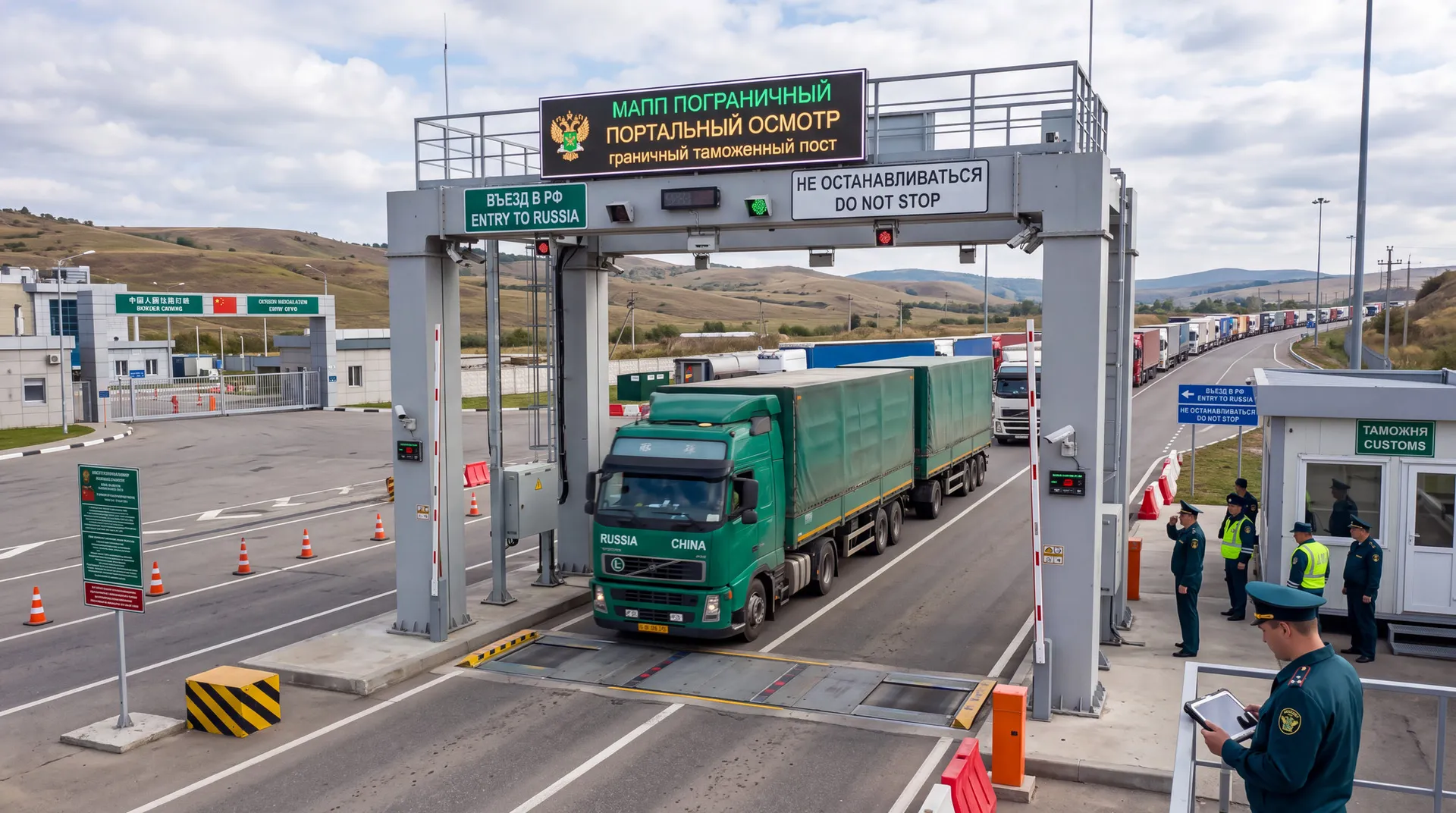
The complex manufactured by Diagnostics-M LLC scans the vehicle with X-rays right in motion: the driver does not get out of the cab, the queue does not accumulate at the inspection line. The equipment has passed the sanitary and epidemiological examination of the Center for Hygiene and Epidemiology in Primorsky Krai and received a conclusion from Rospotrebnadzor on compliance with SanPiN standards. It works in all climatic conditions.
The dose load per driver per scan is no more than 300 nanosieverts (0.3 microsieverts). For comparison: chest X—ray gives 100,000 nSv, an hour of flight in an airplane — 3,500 nSv, computed tomography - 11,000 nSv. Oleg Lyashin, Chief Engineer of Diagnostics-M LLC, explained:
"To receive a dose equal to one standard lung X-ray, a truck driver needs to drive through the complex almost 330 times. According to current sanitary standards in the Russian Federation, the annual dose is 1 million nSv (1,000 mSv), therefore, to obtain a noticeable dose, it is necessary to undergo a scan more than 3,000 times during the year. Therefore, the daily crossing of the border does not carry a dangerous radiation load. During the entire period of using similar speed limits at other checkpoints in Russia, not a single case of exceeding the dose load on drivers has been identified."
Employees of the Ussuri customs are provided with individual dosimeters and monitor the radiation background at the checkpoint during the work shift.
The Border checkpoint is a road crossing on the Russian-Chinese border in Primorsky Krai, one of the key points for cargo traffic between Russia and China in the Far East. Similar PIDCS from the same manufacturer are already operating in the Zabaikalsk MAPP (border with China), Tagirkent-Kazmalyar (Azerbaijan), Mashtakovo and Petukhovo (Kazakhstan). The equipment is provided by the Ministry of Transport of Russia and FGKU Rosgranstroy.
For participants in foreign economic activity who send or receive goods through Primorye, the launch of the PIDK means, first of all, a reduction in the time required to pass through customs control: scanning without stopping reduces the risk of queues during peak loads. The increase in the transportation capacity of the point directly affects the delivery time of goods from China and transit time along the Far Eastern corridor.