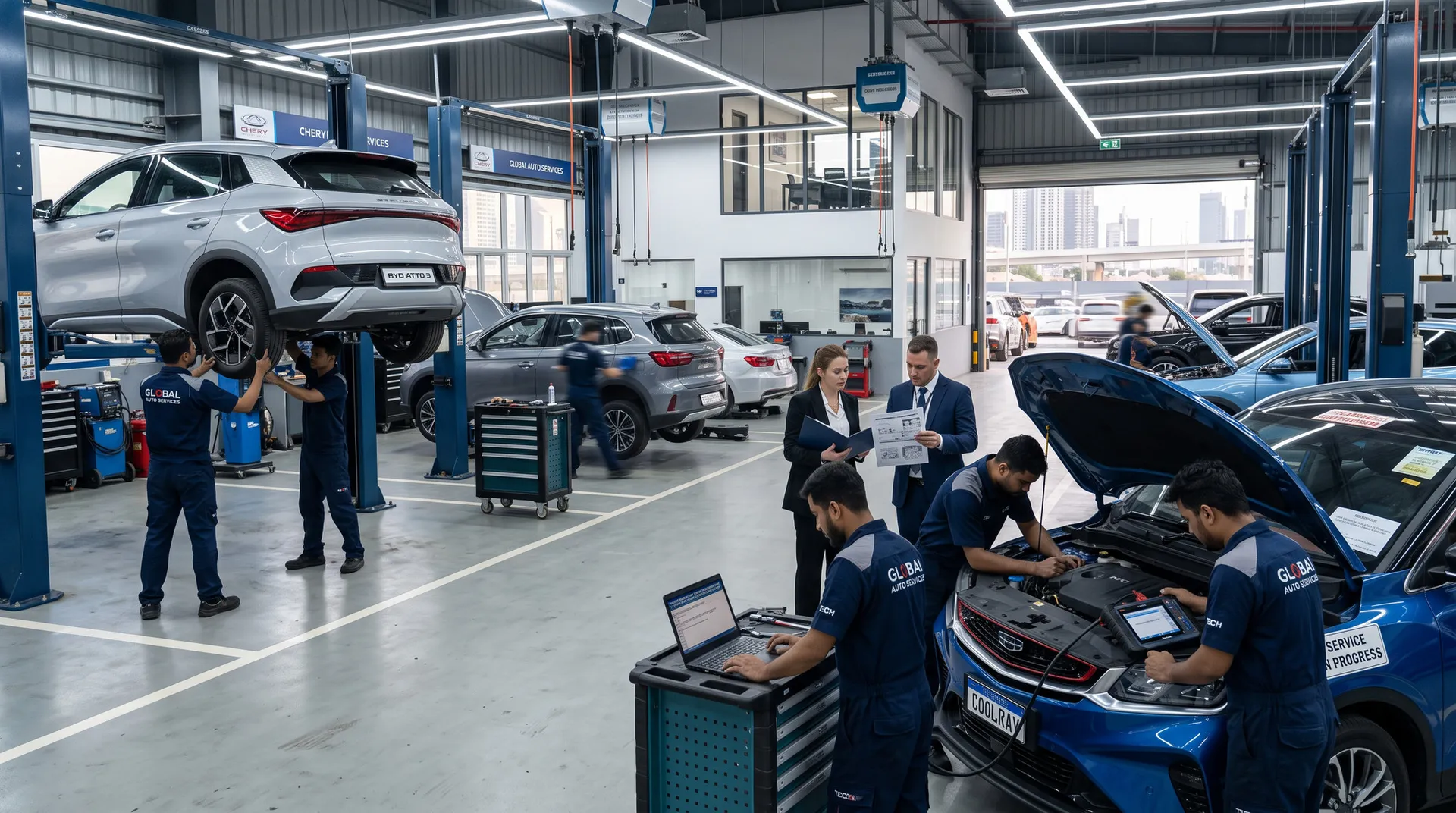
First-class manufacturers will have to confirm the presence of at least 50 foreign service points. The package of documents includes an agreement with the service or an application for its own network, a certificate of the right to repair, a description of repair facilities, photographs of premises, information about equipment, personnel qualifications and spare parts logistics.
The export regulatory system in China has been in place since 2012 — the basic rules were established by Notification No. 318 from the Chinese authorities. The requirement for a foreign service infrastructure was also in effect earlier. A new notification from the Ministry of Commerce extends this approach to 2027, but significantly tightens the standards of documentary evidence.
No significant changes are expected for major Chinese manufacturers. Companies of medium and small management who will not be able to confirm the real service infrastructure are under attack. A separate vulnerable category is cars of foreign brands manufactured in China: after these companies leave the Russian market, direct deliveries from China may not be possible, and such cars will be sent to Russia through third countries where the necessary service network is present.
Georgy Danelia, partner and head of the Asian initiative at SL LEGAL, and Ekaterina Kharina, associate Associate at the company, assess the changes as a tightening of documentary control rather than a fundamental revision of the system.
Vladislav Varshavsky, Managing Partner of Varshavsky & Partners Law Firm, believes that there will be no significant changes for large Chinese manufacturers. However, medium- and small-scale companies may be affected if they cannot confirm the availability of a real service infrastructure.
Artur Leer, President of the Association of Exporters and Importers, confirms that a significant part of cars enter Russia through the CIS countries, primarily Kyrgyzstan and Belarus. The new requirements, in his opinion, will require the restructuring of individual logistics chains, but the market will be able to adapt.
The context is important: in the first quarter of 2025, out of 265,000 new passenger cars sold in Russia, 182 thousand — 68.7% — were related to the Chinese automotive industry. The peak share of Chinese brands occurred in 2024 — 58% of the market. At the same time, localized production is growing: the Tenet and Solaris brands at the former Volkswagen and Hyundai enterprises occupied 12.4% of the market in January–April 2025, or 47.4 thousand cars.
Importers working with small Chinese brands or parallel imports of global Chinese—made brands should check in advance whether the supplier has a confirmed service network in the country of shipment, otherwise the export license may simply not be issued from 2027.
Related materials:
- Ecological class of cars upon import: ZOETS instead of OTTS until the end of 2026 — what documents are needed for the imported car now
- Korea closed the channel: 1024 cars left with forged documents — how does the import of cars through third countries end up bypassing the rules
- Preferential car recycling: 5 schemes that will make you pay 100 times more — which import schemes result in additional charges