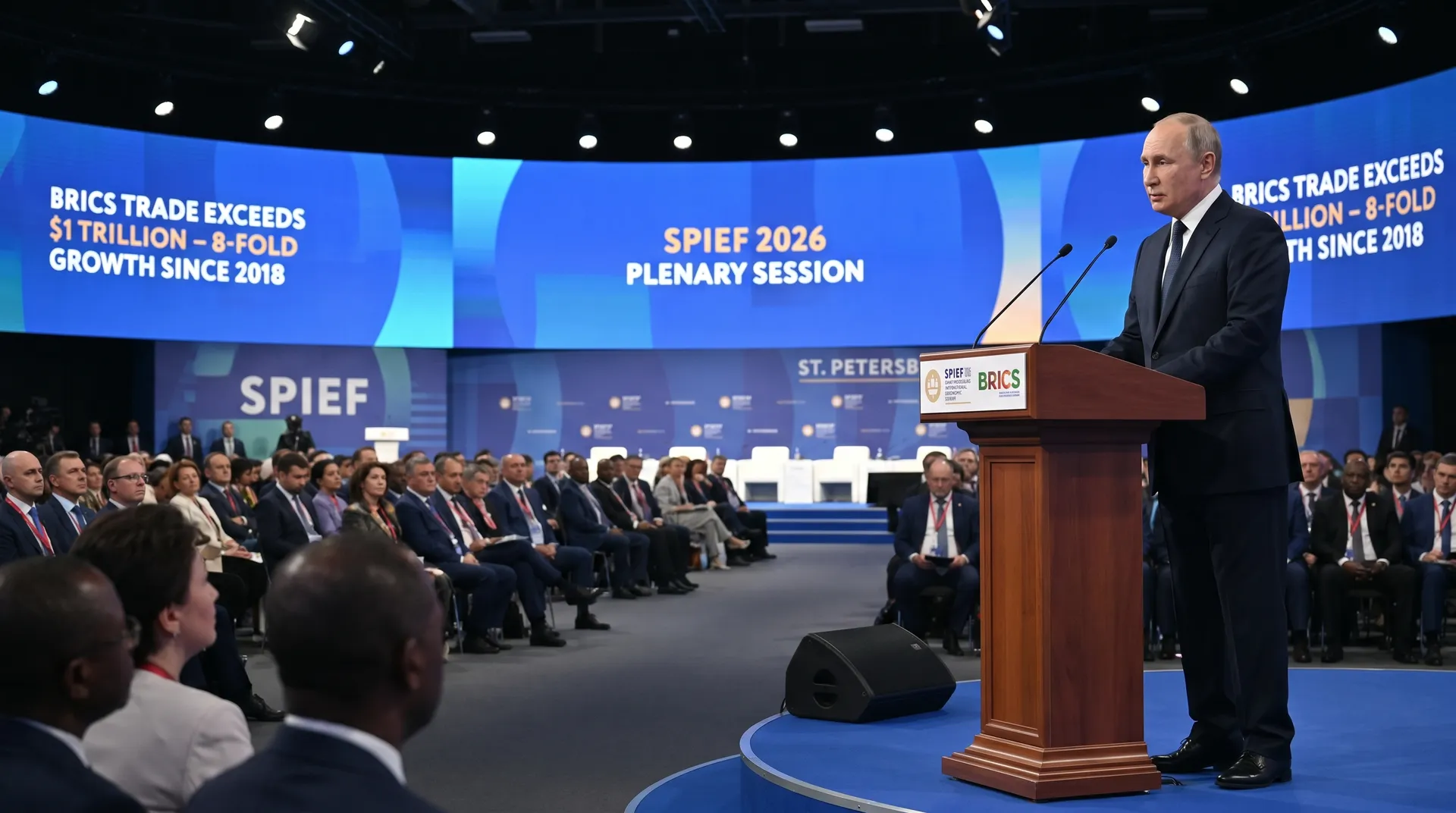
The $1 trillion figure is not just a beautiful guideline for a press conference. This is a measurement of how much the architecture of global trade has changed in eight years.
In 2018, Putin spoke at the SPIEF about $125 billion within the BRICS. At that time, there were five countries in the bloc: Brazil, Russia, India, China, and South Africa. Now there are ten: the UAE, Iran, Ethiopia, Egypt, and Indonesia have been added. Plus 10 partner countries, including Belarus, Kazakhstan, Uzbekistan, Malaysia, and Thailand.
The expansion of the block and the eight—fold increase in trade turnover were two processes that ran in parallel and reinforced each other.
What is worth for $1 trillion
Russia–China: over $260 billion is expected by the end of 2026. This is the largest bilateral trade within the bloc — and one of the largest in the world. 100% of payments in rubles and yuan.
China–India, despite political tensions: about $130 billion India–UAE: about $90 billion. Russia–India: record $60+ billion in 2025, growth continues.
For comparison, the total trade turnover between Russia and the EU countries in 2021 was about $280 billion. BRICS has replaced the Western vector not only politically, but also economically.
Why is this important for calculations?
A trillion dollars of trade within the block is a constant pressure to create a single settlement infrastructure. If 90% of this turnover goes through dollar correspondent banks, this is a vulnerability. This is why Brazil is lobbying for BRICS Pay, Russia is promoting the digital ruble, and China is expanding CIPS.
The infrastructure does not appear immediately. But with $1 trillion in trade, the incentive to build it is maximum.
A practical angle for business
For companies trading with BRICS partners: The room for maneuver is expanding every year. New routes, new payment channels, new trade agreements — all this is a consequence of the fact that the block has become a truly large trading space.
The next BRICS summit is in India in 2026. BRICS Pay and further expansion will be discussed there. The results of the summit have a direct impact on the payment infrastructure for Russian businesses.