




The agreement will be presented at a meeting in Salalah, a southern Omani city where it was planned to gather the foreign ministers of the Gulf Cooperation Council countries. The parties intend to agree on details, including the amount of fees from passing vessels, later.
Iranian Foreign Minister Abbas Araghchi called the upcoming meeting an "important event" and a step towards building trust. At the same time, Tehran made it clear that the deal does not mean a complete resumption of navigation: the right to allow or detain specific vessels remains with Iran.
A rare public meeting between Crown Prince of Abu Dhabi Sheikh Khaled bin Mohammed Al Nahyan and Iranian President Masoud Pezeshkian took place on the sidelines of the BRICS summit in India. According to the UAE state agency WAM, the parties stressed the need to reduce tensions and strengthen regional stability. Anwar Gargash, adviser to the UAE President, described Pezeshkian's position as "balanced and rational," and the meeting as a combination of deterrence and diplomacy.
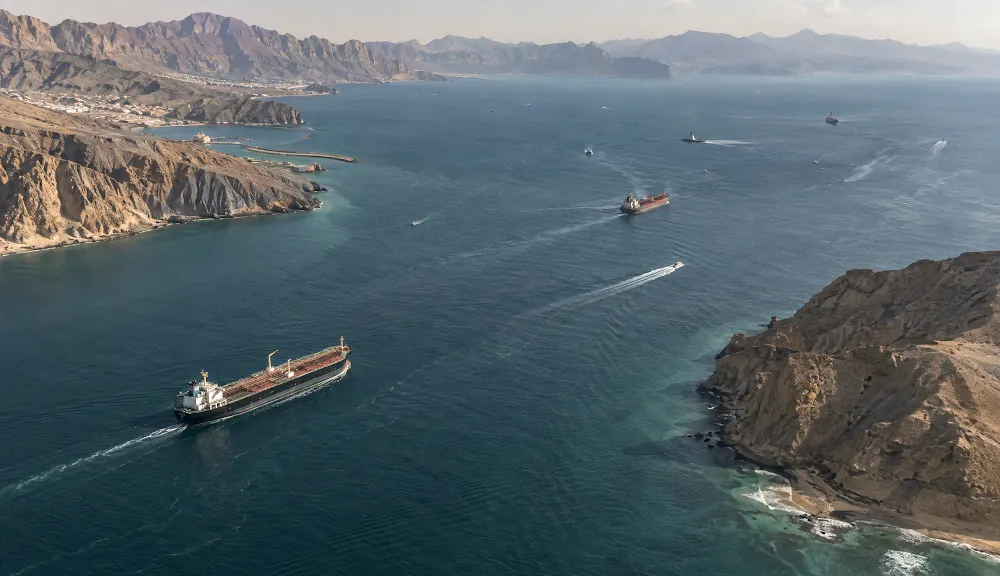
The conflict began in late February after the US and Israeli strikes on Iran. Since then, Tehran has effectively blocked the Strait of Hormuz, through which a critical energy flow passes. The United States and Iran exchanged strikes on oil tankers in the Persian Gulf. Over the weekend, the British service UK Maritime Trade Operations reported a fire on a ship hit by a shell. The Iranian state television IRIB confirmed the attack on a merchant ship off the islands of Qeshm and Hengam: one person was killed.
Amid the ongoing conflict, Saudi Aramco on Sunday shut down the "East—West" pipeline, a key alternative to the Strait of Hormuz for oil exports, due to drone attacks by Iraqi groups. The company's shares fell by almost 1.1%, reaching their lowest level since March.
Participation in the negotiations remains incomplete. Bahrain declined to participate in the meeting, citing recent attacks that Manama links to Iran. The escalating fighting between Saudi—backed forces and the Houthis, a Yemeni group supported by Tehran, is also complicating the negotiation process.
The UAE officially severed economic ties with Iran in August, but has consistently advocated a political settlement. Gargash warned last month that the state of "neither war nor peace" is unstable, and called for the restoration of normal navigation through the strait.
For participants of foreign economic activity working with supplies through the Persian Gulf, the temporary corridor is a signal to reconsider the route logic: as long as the conditions of passage and tariffs are not fixed, insurance risks and freight rates in the region will remain at an elevated level.
Related news:
- Tanker freight through the Strait of Hormuz jumped by 600%
- Trump demanded 20% of the cost of cargo for passage through Hormuz
- Insurance premiums for passage through Ormuz increased 14 times