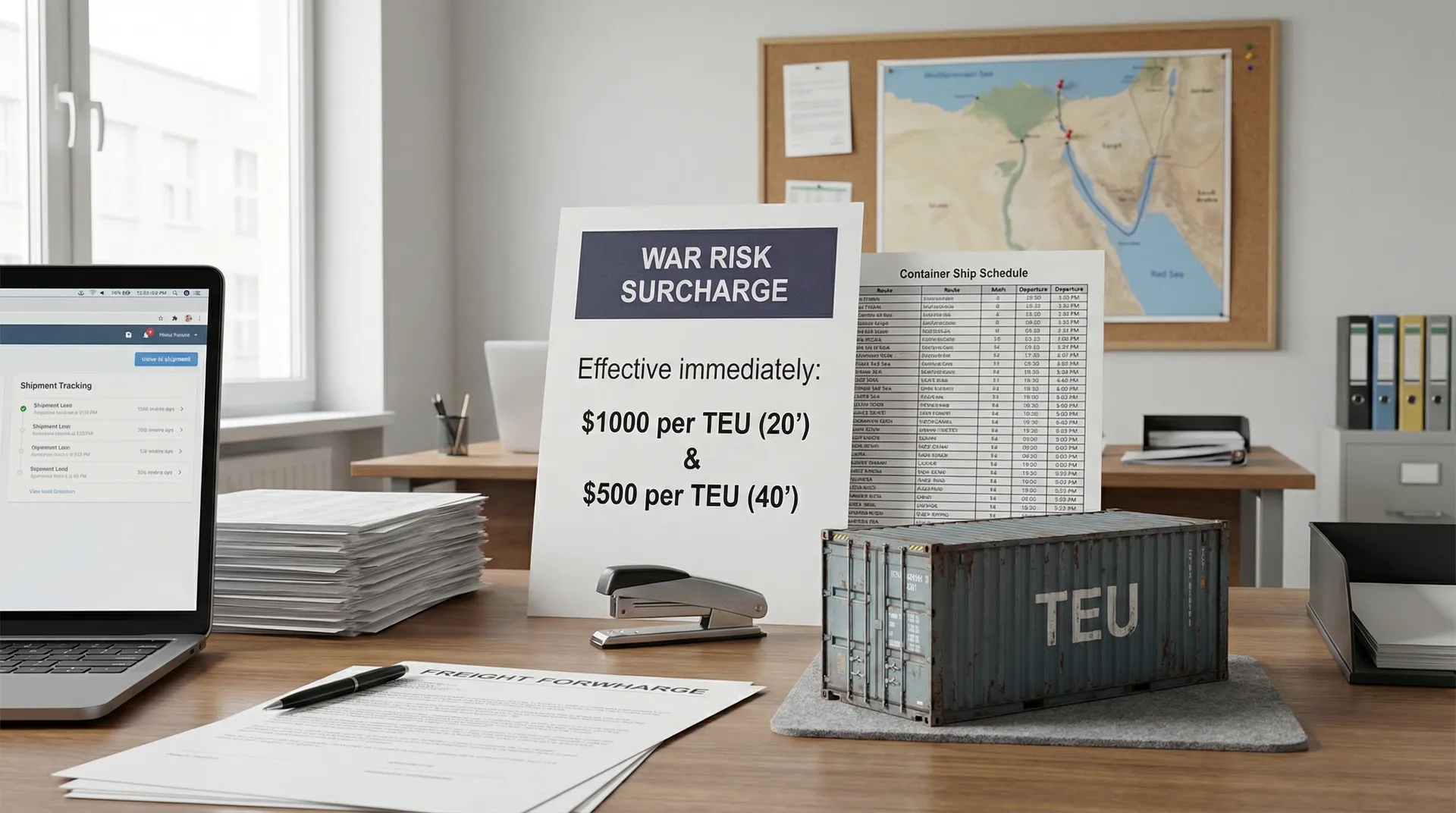
For Russian importers from China and Asian countries, the problem is becoming applied: any delay in making a booking decision turns into a direct surcharge per unit of container capacity. The market has already established guidelines for the amount of charges: in some risk zones there are levels of about $1,500 per TEU and $3,000 per 40-foot container, and in some areas the rates reach even higher values depending on the port and type of equipment.
Against this background, transparent calculation logic is becoming increasingly important. Differentiation by actual route stage reduces conflict between supply chain participants and gives businesses a clear cost corridor. That is why the model where the maximum surcharge is applied to new bookings, the lower one to cargoes in the approach to the risk zone, and for containers that have already passed the critical section, the charge is removed, becomes the “working” standard for uncertainty management for the market.
The practical effect for foreign economic activity is simple: the rules of budgeting are changing. In contracts with suppliers and in transportation requests, it is necessary to specify who is responsible for the surcharge, on what date the rate is fixed and which documents confirm the passage of the route. A separate layer of tasks arises for companies with regular shipments to marketplaces and seasonal sales: the cost of risk is instantly transferred to the cost of a unit of goods, then to the price and margin, then to the competitiveness of the card.
In the coming weeks, the key business request will be reduced to two actions: receive notifications of surcharges before the cargo leaves the port and have checkpoints in the route confirming exactly where the container is located relative to the Suez Canal and the Red Sea. The faster the supply chain learns to document this status, the fewer disputes over charges there will be and the more accurate the forecast of the final cost of delivery will become.