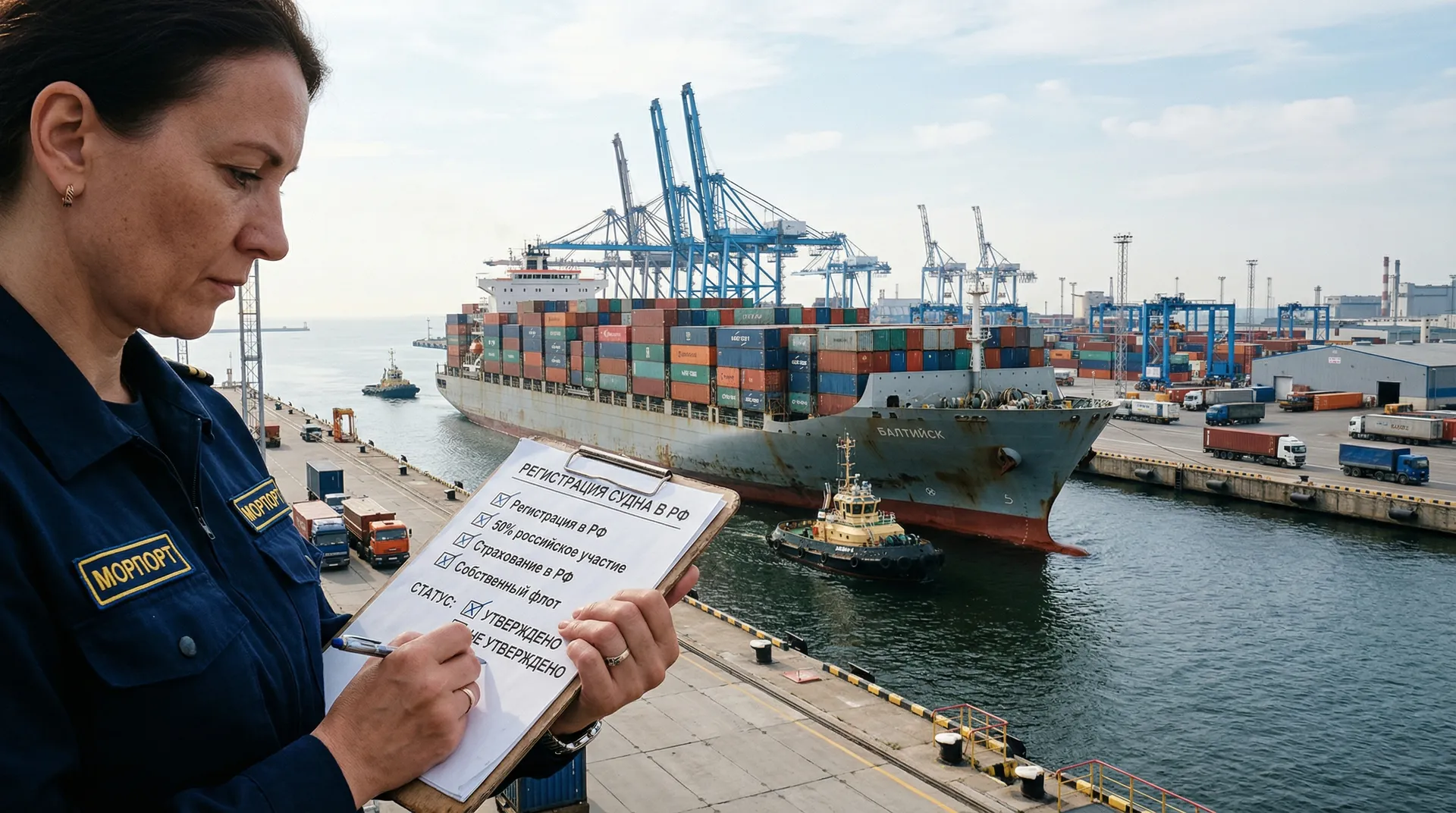
The Ministry of Transport and the government are forming a strict admission regime for global container operators who may try to return to regular foreign trade shipments calling at Russian ports. According to Interfax, the package of measures is being coordinated and may be approved in 2026. Alexander Poshivai, Deputy Head of the Ministry of Transport, when asked about the timing, said: "Of course, it is planned to be approved this year."
The essence of the project is that the carrier, shipowner and operator of the line must be registered in the Russian jurisdiction and be under Russian control. The list of key requirements cited by the sources includes:
- registration of the shipowner, carrier and operator under Russian law;
- the share of the final Russian participant is more than 50%;
- ship and liability insurance in Russian companies or reinsurance in Russia;
- consent to the consideration of disputes in Russian courts at the choice of the plaintiff and the consolidation of Russia as a place of corporate dispute resolution;
- the obligation to receive and transport sanctioned goods and cargoes from sanctioned senders or recipients as a matter of priority;
- the use of operator-owned vessels on the line and the performance of transportation along the route by own vessels without relying on charter solutions.
A "list of restricted" companies is being discussed separately, with which communication will be prohibited for the shipowner/carrier/operator. The materials mention Maersk, CMA CGM, Hapag-Lloyd, ONE and others, for a total of ten positions. However, the MSC is not included in the list.
Lawyers and market participants pay attention to the wording of the restriction of communication with companies from the list. The publication provides an assessment by a corporate lawyer who interprets the rule as harshly as possible.: "I interpret it in such a way that not a single percent should belong."
For participants in foreign economic activity and port logistics, the consequences can manifest themselves quickly. Reducing the number of available operators increases the risk of rising rates and lengthening deadlines. An additional factor is the requirement to work only in our own fleet.: it changes the mechanics of covering demand peaks and limits routing flexibility. If the rules are adopted in their current form, companies will have to prepare alternative delivery schemes in advance, renegotiate contract terms and apply increased uncertainty allowances.