




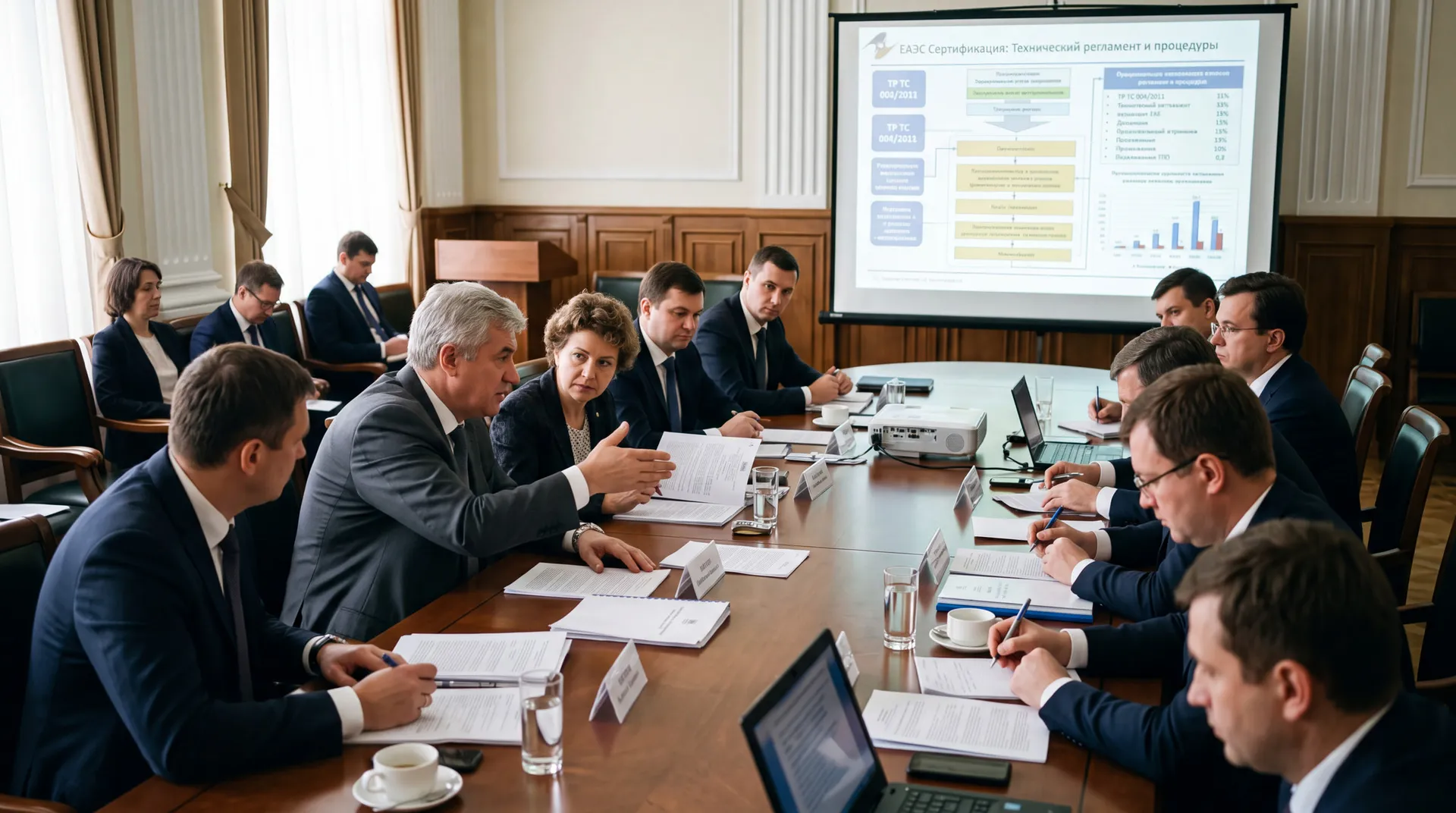
A meeting of the Council of Heads of Accreditation Bodies of the EAEU Member States was held in Moscow with the participation of Alexander Subbotin, Minister for Technical Regulation of the EEC. The central issue was the implementation of paragraph 3 of the Decision of the Supreme Eurasian Economic Council dated December 21, 2025, No. 20.
The participants reviewed the draft regulations of the Eurasian Intergovernmental Council and a set of measures against unscrupulous participants in the conformity assessment market. The measures are aimed at suppressing the activities of certification bodies and testing laboratories that issue documents with violations or false information, as well as at eliminating distortions of competition when products are put into circulation on the single market.
The practical problem is as follows: a certificate or declaration of conformity issued in one EAEU state is valid throughout the Union. If such a document is based on a falsified test report, the unsafe product passes unhindered through the borders of all member countries. That is why violations of individual laboratories affect not only the national, but also the entire Union market.
To solve this problem, a draft algorithm for the interstate exchange of information has been developed. The mechanism will allow the competent authorities of one state to request from colleagues from another EAEU country confirmation of the issuance of a specific test report. Representatives of the countries made proposals on the timing of consideration of such requests and the composition of the information provided. The final parameters of the algorithm have not yet been approved.
"Combining the efforts of accreditation bodies makes it possible to create a reliable barrier for unscrupulous conformity assessment bodies and protect the Union's single market from unsafe products," said Alexander Subbotin.
A separate item on the agenda was the modernization of the unified register of conformity assessment bodies of the EAEU, which is maintained on the basis of the Decision of the EEC Council dated December 5, 2018 No. 100. The register contains information about accredited certification bodies and testing laboratories. The participants discussed the readiness of national information systems for the transition to version 2.1.0 of the general process No. 36. The launch of the updated version is scheduled approximately for the end of the first quarter of 2027. The EEC did not disclose specific functional changes to the new version.
The meeting also adopted the final report on the results of the second mutual comparative assessment of the Armenian accreditation body. At the same time, a similar procedure has begun with respect to the accreditation body of Belarus — at the first stage, a documentary assessment of the national accreditation system is being conducted.
For importers importing products subject to mandatory certification under the EAEU technical regulations, increased interstate information exchange increases the likelihood of identifying problematic documents during customs clearance or market surveillance in the destination country. Bona fide market participants will receive a more reliable counterparty verification tool through the updated registry. So far, all the mechanisms discussed remain at the draft stage: no new mandatory procedures have been introduced for importers following the meeting. Practical changes will occur after the approval of the documents and the launch of information systems.
Related news:
- Rosaccreditation has updated the methodology for evaluating ICI providers — how has the assessment of certification bodies changed
- Unified electronic Certificate for fish exports to the BRICS countries: Russia's initiative — how electronic certification for exports to the BRICS works
- The honest mark is integrated with the SPOT to control labeled imports — how will the marking connect to the import control system
- The EAEU—UAE Agreement has entered into force: how the new tariffs work — what tariffs are in effect under the agreement with the UAE