The Ministry of Finance named the trends in the regulation of e-commerce in 2026: the EAEU Customs Code and the Federal Tax Service
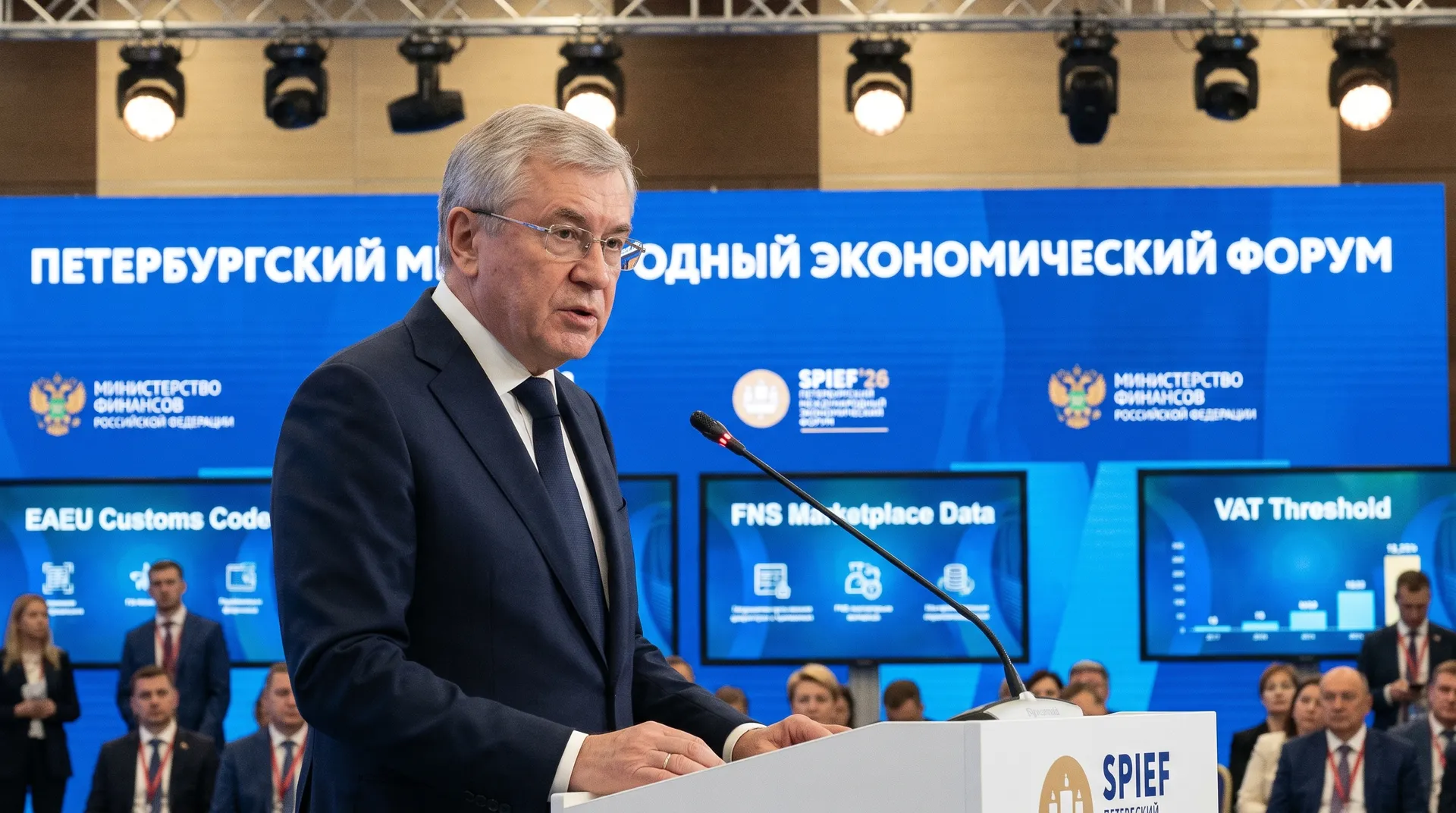
Russian regulation of electronic commerce is moving along two parallel tracks: domestic legislation (the law on the platform economy, amendments to the Tax Code of the Russian Federation) and supranational (EAEU TC). At the SPIEF, Sazanov publicly indicated for the first time the readiness of the Ministry of Finance to move along the second track.
"We understand the demand for such operations from sellers and, of course, we are ready to meet business halfway, discuss and jointly work out changes to the EAEU Customs Code, since we are talking about supranational regulation here," the deputy minister said.
Trend 1: marketplaces become agents of the Federal Tax Service
Starting in October 2026, Wildberries, Ozon, Yandex.Market and other platforms are required to transmit monthly data to the Federal Tax Service on the turnover of all sellers, without exception, not only suspicious ones. Until now, reporting has been selective, in the pilot mode according to the fragmentation schemes. Now the tax authorities see the whole picture.
Alexey Krylov, member of the Chamber of Commerce and Industry's expert council on financial markets: the pilot has already allowed us to uncover many gray schemes and obtain voluntary additional taxes from sellers. The budget has received additional revenue, and it is logical that the mechanism scales to everyone.
Trend 2: lowering the VAT threshold
The threshold for VAT exemption for marketplaces is decreasing: from 60 million rubles per year to 20 million in 2026 and to 10 million rubles by 2028. For sellers whose revenue is in the range of 20-60 million per year, from 2026 there will be an obligation to pay VAT, which did not exist before. This affects the middle layer of marketplace sellers — not big businesses or micro ones.
Trend 3: changes in the EAEU Customs Code
This is the most long-term track. The EAEU Customs Code is a supranational document that regulates customs clearance in all five countries of the union. Changes to it require coordination at the level of the EEC and all member states — that is, a longer coordination cycle than domestic Russian laws.
The specific directions of the changes at the SPIEF were not detailed. But the very fact of a public statement of readiness to work out changes in the EAEU Customs Code, taking into account the interests of marketplace sellers, is a signal that the issue of customs clearance of marketplace goods at the EAEU level will be discussed in detail.
What does this mean for the foreign economic activity business right now?
Until October 2026: bring tax accounting in line with what the Federal Tax Service will see through marketplace data. Any discrepancies between the turnover on the site and the tax reports after October will be the basis for a request from the Federal Tax Service.
For sellers with a turnover of 20-60 million rubles: calculate whether it is beneficial to voluntarily switch to VAT ahead of schedule or wait for a mandatory transition. Under certain conditions, an early transition allows you to deduct "incoming" VAT from suppliers, which reduces the real burden.