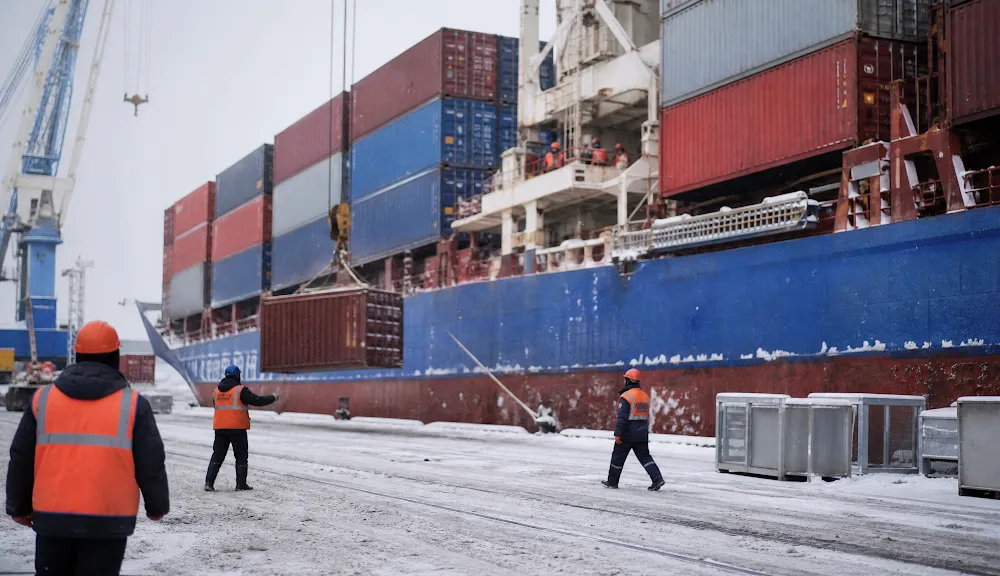
On September 8, the container ship NewNew Shipping Line left Murmansk with a return cargo of 26.4 thousand tons of potash fertilizers for Southeast Asian countries. The trial flight has become a full-fledged two-way route.
Alexey Fadeev, Doctor of Economics, Head of the Expert Council on Arctic Development at the St. Petersburg Committee on External Relations, commented on the significance of the event.:
"Today Murmansk is changing its status. It is not just the capital of the Russian Arctic. Thanks to the global events that are currently taking place, Murmansk is becoming the largest transit and logistics hub in the north-west of our country. And the first such flight proves it."
According to him, the development of the Murmansk transport hub and the railway connection to St. Petersburg open up a potential connection with the "North—South" corridor. This moves Murmansk from being a regional port to a hub for global trade.
The Northern Sea Route provides almost two-fold savings in terms of delivery time compared to the southern routes. The route is devoid of pirate threats and is considered more predictable. The main limitation is the navigation season, which lasts no more than four months. It can be extended either by icebreaking or by high—ice-class vessels - both options significantly increase the cost of transportation.
NewNew Shipping Line intends to resolve this issue in the fall of 2024 by putting four high-ice-class container ships on the line. The company has been operating on the NSR since 2024: a service called "Arctic Express" operates from Arkhangelsk.
Fadeev emphasized the commercial logic of what was happening:
"It is simply impossible to force an international business to do what it does not want to do. Business chooses the shortest, most convenient and safest route, which is the Northern Sea Route, already today as an integral part of the Transarctic Transport Corridor."
For the participants of foreign economic activity working with China and the countries of Southeast Asia, it is of practical interest not only to reduce transit time, but also to diversify routes. So far, the NSR remains a seasonal and expensive tool, but the expansion of the ice-class fleet and an increase in the frequency of flights may change the economics of the route in the coming navigation seasons.
Similar materials on the website
- China — Tashkent — Liege: a new multimodal route for e-com cargo is another bypass corridor from China, already by air
- Northern Sea Route: 20 days to Europe instead of 40 via Suez — what started the regular Arctic service this season
- Maersk introduces surcharges from South America and Scandinavia — why traditional sea shoulders are becoming more expensive