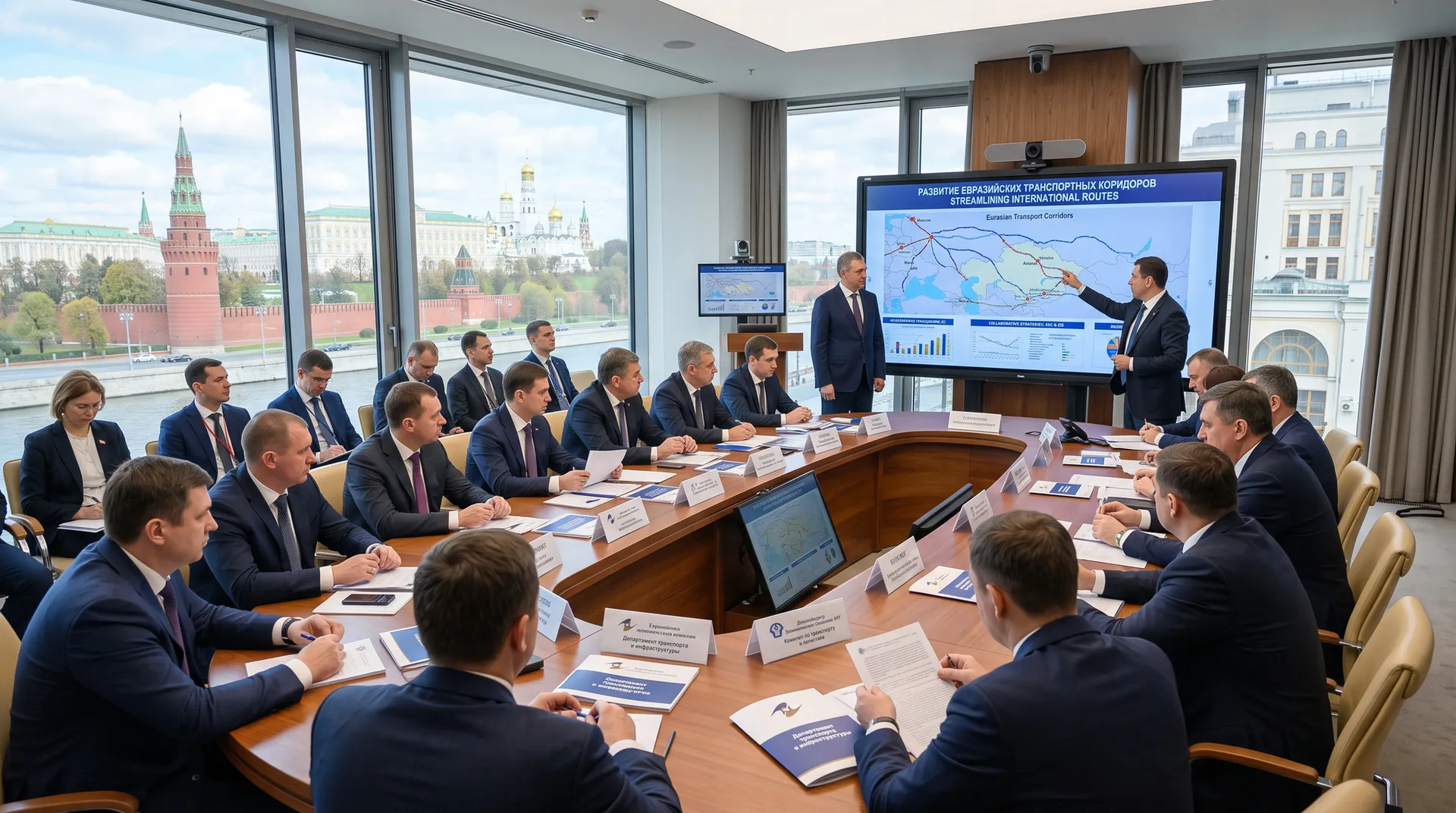
The North—South International Transport Corridor is expanding its membership. The interest of the countries of the Persian Gulf and Southeast Asia in the project was announced by the Minister of Transport of Russia Andrey Nikitin.
Memoranda on the corridor have already been signed with Iran, Bahrain, Afghanistan and Oman. The Ministry of Transport is preparing similar documents with Qatar, Saudi Arabia and a number of other countries. The ministry does not specify the date of signing. Separately, routes towards Pakistan and through Afghanistan are being worked out in conjunction with the Trans-Afghan Railway project.
The corridor itself is a 7,2 thousand-kilometer multimodal route from St. Petersburg to the Indian port of Mumbai. Its western branch runs through Azerbaijan and Iran, and the key unfinished link remains the Rasht—Astara section, the documents on which Russia and Iran signed in May 2023.
The practical meaning of connecting the Gulf countries is in ports. The Gulf States are not interested in transit through their territory, but in connecting their own port facilities to the route. For the cargo owner, this means the emergence of additional transshipment points on the southern arm: supplies along both routes of the corridor could potentially go through the Saudi port of Dammam, while Iraq is working on connecting the ports of Basra, Fao and Umm Qasr.
It is worth evaluating the news soberly. The MOU does not create a schedule, a tariff, or a guaranteed slot. The real effect appears when the document is followed by end-to-end logistics services with one operator and one rate along the entire route, and the Ministry of Transport is working on this together with Iran and Azerbaijan.
What should companies working in the southern direction do? To keep the corridor in the model as an alternative to the sea shoulder through Suez and Hormuz, especially against the background of restrictions in the strait. To request from freight forwarders the current through rates and the actual dates for the western route — the figures are very different from the estimated ones. And keep an eye on the Rasht—Astara section: it is he who determines whether the corridor will become competitive in terms of timing, and not just in terms of the political framework.
Similar materials on the website
- Hormuz: Iran has started issuing permits for tanker passage — why is an onshore alternative to the sea shoulder back on the agenda